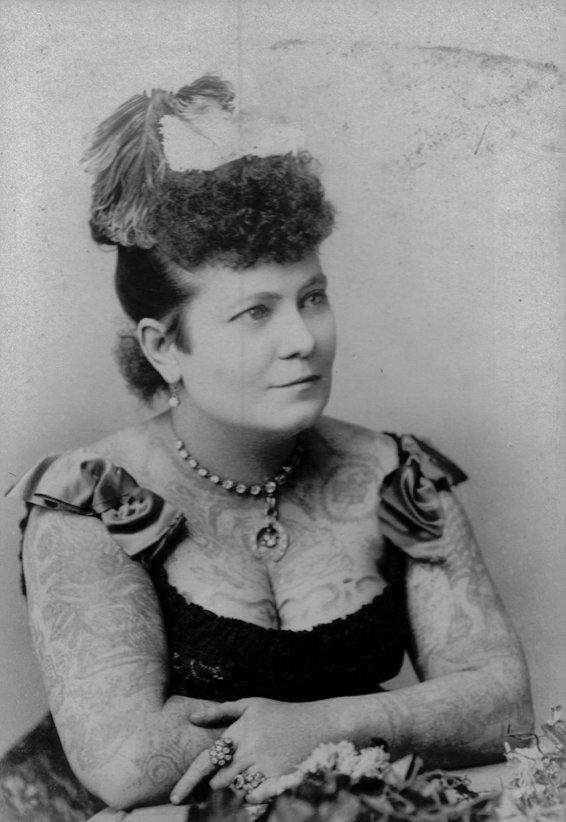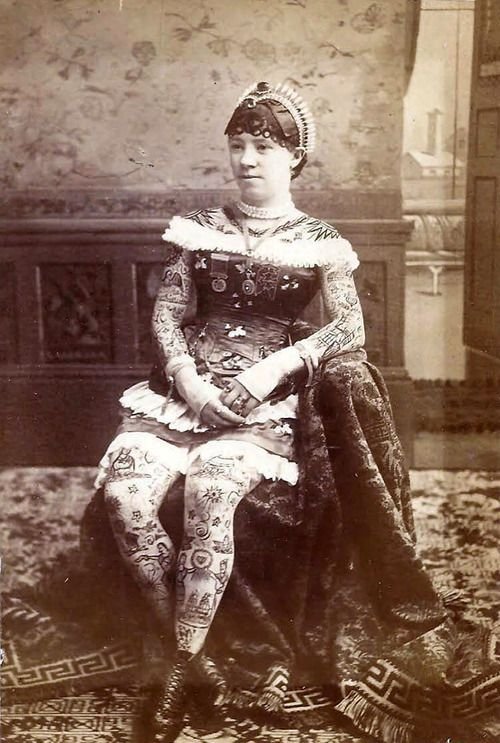

In 1882 Nora Hildebrandt stepped onto a New York dime-museum stage as a tattooed woman, one of the first to make that work a career in the United States.[1][3] The tattoos were credited to Martin Hildebrandt, already the city’s best-known professional tattooer.[1] She took his surname. Publicity often called her his daughter, and some later writers have called her his common-law wife. Research published by the South Street Seaport Museum in January 2026, following Michelle Myles, finds that she was born in England and was neither married to him nor related to him.[1][2] This page follows that correction, and it treats the captivity story used to sell her act as the fiction it was.
Quick facts
- Born
- England, in the 1850s (the Seaport Museum gives circa 1857; a promotional pamphlet claimed Melbourne, 1860)
- Died
- The Seaport Museum gives circa 1893; we have not independently confirmed a death record
- Known as
- Lady Nora Hildebrandt; the surname was taken, not inherited
- Debut
- Bunnell’s Dime Museum, 1882 — on the Bowery in the Seaport Museum’s account; her pamphlet, via the Tattoo Archive, places the engagement at Broadway and 9th Street from March 1, at $100 a week
- Tattoos
- Credited to Martin Hildebrandt; publicity claimed 365 designs
- Partner onstage
- The Seaport Museum identifies Captain Jacob Hildebrandt as Brooklyn brewer Jacob Gunther, who performed with her
England, a taken name and a fabricated story
The Seaport Museum’s 2026 note places her birth in England, around 1857.[1] Michelle Myles had already written that she was born in England.[2] A promotional pamphlet, as summarized by the Tattoo Archive, claimed instead that she was born in Melbourne in 1860.[3] Wikipedia, following later biographical work, says she was born poor in London in the 1850s under another name.[4] The English birth is the point on which the recent museum research and Myles agree; the Melbourne story belongs with the rest of the publicity.
That publicity was built on a captivity narrative. The pamphlet said she and her father had been abducted, that she had been tattooed by her father six hours a day for a year, and that the designs numbered 365 — one for each day.[3][1] The Seaport Museum describes the tale as fabricated, part of a then-common, racist genre in which white performers invented abduction by Indigenous people for the box office.[1] It is not a biography, and it should not be repeated as one.
In reality, the museum and Myles agree, she was tattooed by Martin Hildebrandt. She assumed his surname and was often presented as his daughter or his wife. She was neither.[1][2]
Bunnell’s Dime Museum, 1882
Her professional debut was in 1882 at Bunnell’s Dime Museum in New York, where she displayed the tattoos her publicity numbered at 365.[1] The Seaport Museum locates that appearance on the Bowery.[1] The Tattoo Archive, citing her own pamphlet, gives an engagement from March 1, 1882, at Bunnell’s at Broadway and 9th Street, at a hundred dollars a week.[3] The two accounts agree on the museum, the city and the year; they differ on the exact corner. We give both.
The timing matters because of a rivalry. Irene Woodward, billed as “the original tattooed lady,” had a reception at the Sinclair House on March 18, 1882, and debuted at Bunnell’s on March 20.[7] If Nora’s March 1 date is right, she was on the same circuit a few weeks earlier. Newspapers noticed. A New York Times review in 1882, as later writers have noted, mocked Nora’s looks.[4] The contest over who was “first” was already a publicity tool, not a settled historical title.
The road, a partner and the end of the record
She toured as a tattooed lady, including with circuses later writers have listed among the Barnum & Bailey dates.[6] The New York Clipper of March 22, 1884, reported gifts she had received in Mexico: a pony, an eagle, a pet tiger, a monkey and birds.[4] The list reads like circus press, and it is at least evidence of how far the act had already traveled.
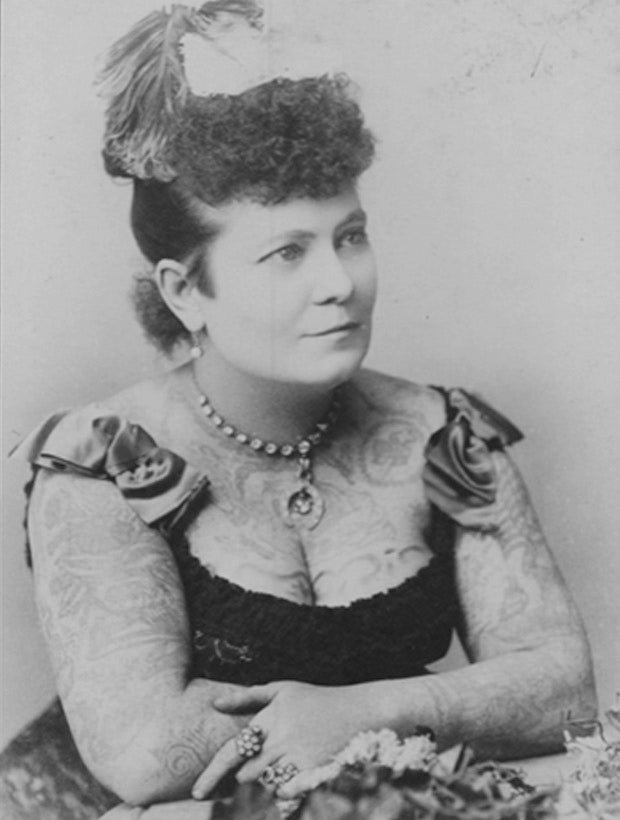
The Seaport Museum, describing cabinet cards it acquired in 2025, identifies a partner on the circuit: Captain Jacob Hildebrandt, in fact a Brooklyn brewer named Jacob Gunther, who performed as a tattooed man alongside her. Charles Eisenmann photographed both around 1890.[1] The shared surname, again, was a billing choice.
The museum gives her dates as circa 1857 to 1893.[1] We have not independently confirmed a death record, and earlier research treated the date of her death as unknown. We report the museum’s figure and leave the confirmation open. What the 1882 notices and the 2026 correction do settle is the shape of her working life: an English-born woman, tattooed in New York, who took a famous tattooer’s name and a false origin story, and who helped invent the American tattooed-lady act in the first season it became a business.
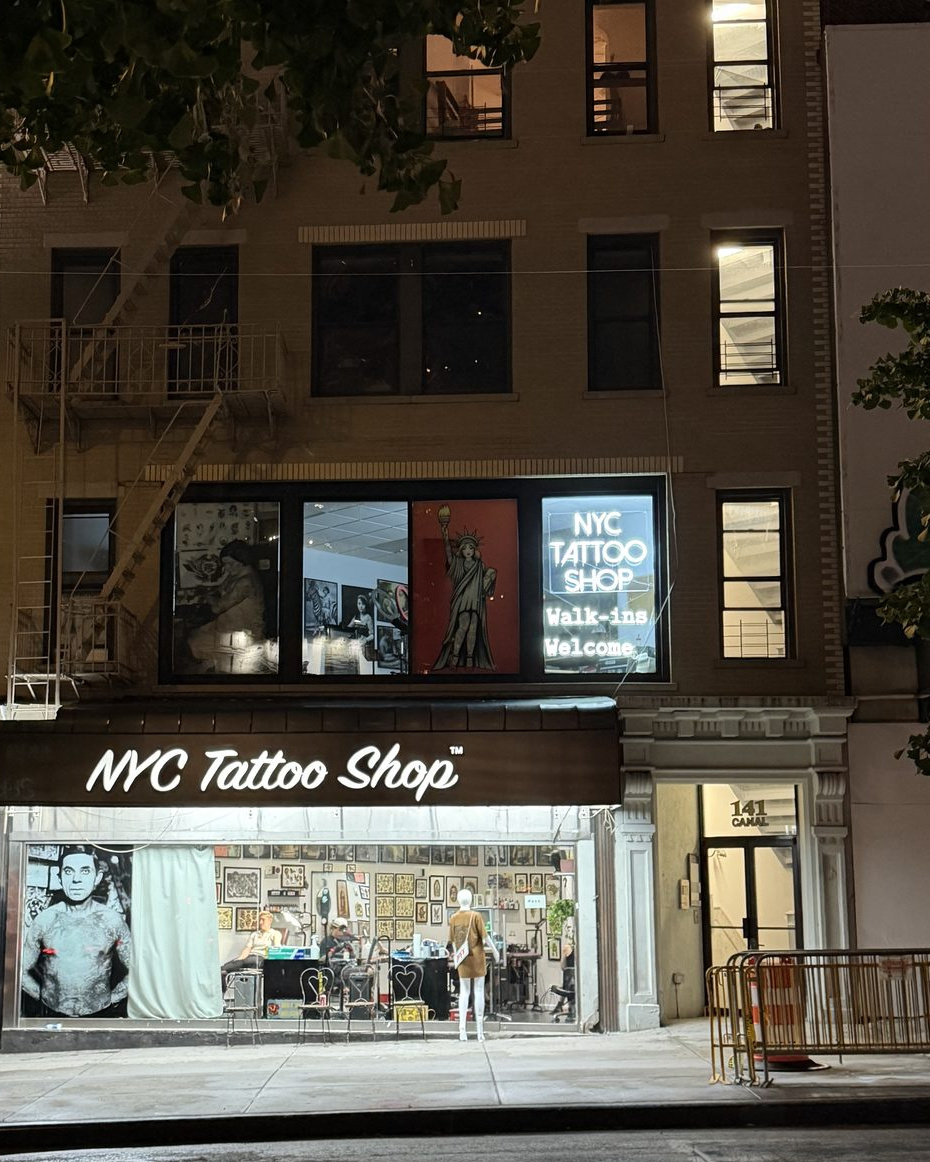
NYC Tattoo Shop is at 141 Canal St, a short walk from the old Bowery dime-museum district. The history here belongs to New York. We’re proud to work nearby.
Photo gallery
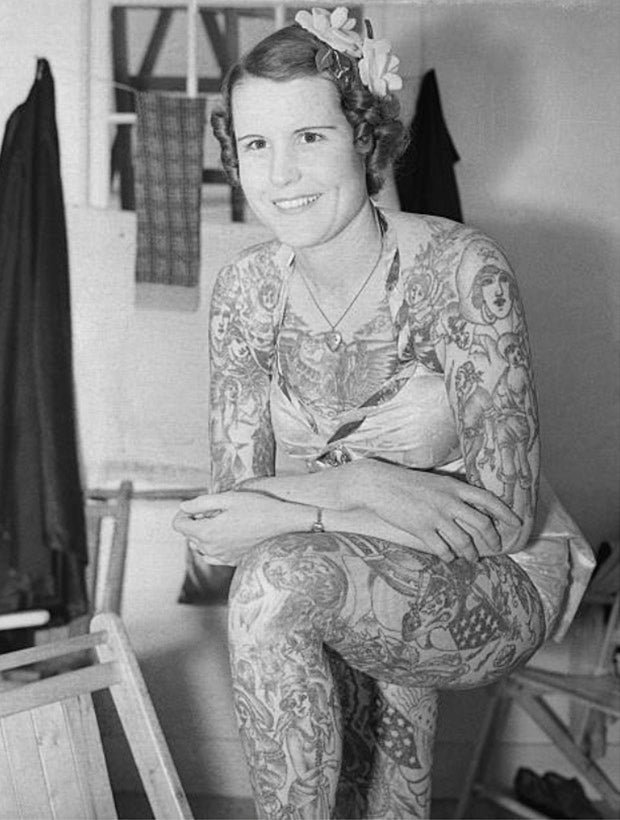
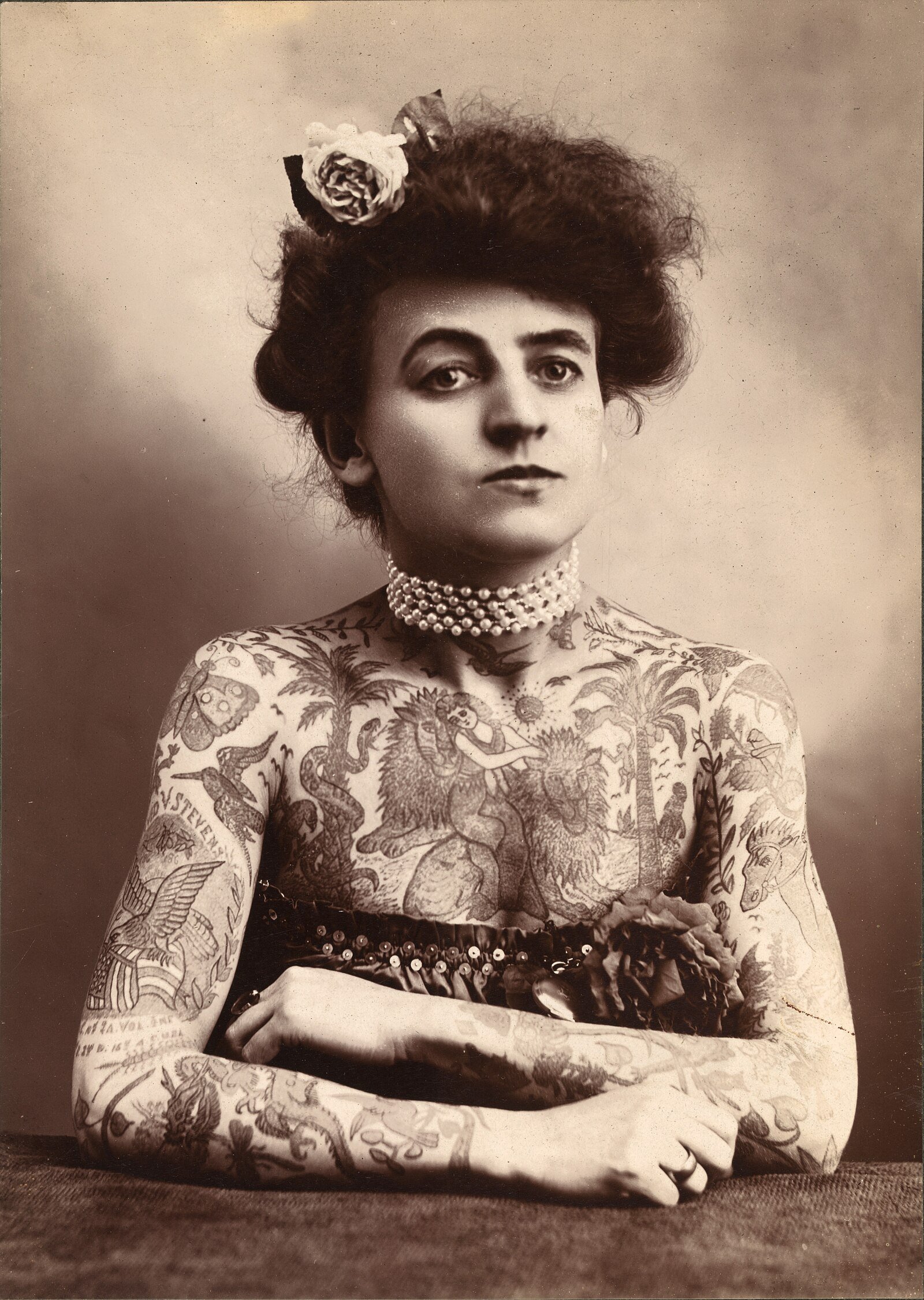
The Eisenmann albumen print is in the public domain, via Wikimedia Commons. The lace-dress portrait is from the NYC Tattoo Shop History Digital Archive.