
Elmer E. Getchell’s name sits on one of the most important doors in New York tattooing: 11 Chatham Square.[1] He opened there in 1899, after splitting with Samuel O’Reilly, and his card billed him as “inventor of the vibrating electric tattooing machine.” O’Reilly, who already held the first U.S. tattoo-machine patent, took him to federal court.[1][6] This page treats the card as Getchell’s own claim, sets it beside the patents we do have, and follows him, cautiously, after he left the city.
Quick facts
- Born
- 1863 (secondary sources; primary record not seen here)
- Died
- 1940 (same caution)
- Known as
- “Captain” Elmer E. Getchell
- Shops
- 5 Chatham Square (with O’Reilly, 1897–99); 11 Chatham Square (1899–c. 1904). Later cards and directories place him in Washington, D.C., and, if the same man, in Norfolk, Virginia
- Claim
- His 11 Chatham Square card calls him “inventor of the vibrating electric tattooing machine”
- Dispute
- O’Reilly sued him in 1899 over U.S. Patent 464,801; the outcome is unclear
Boston, “Captain,” and the years before Chatham Square
Secondary accounts give Getchell’s dates as 1863 to 1940.[4][3] We have not seen a birth or death certificate, and those years should be read as reported, not as a document we have checked.
By the late 1870s, auction-house and later accounts say, he was already tattooing by hand in Boston, and is credited with dime-museum bodysuits on Fred Hadley and Frank DeBurgh.[3][4] A later card, from about 1927, styles him “Captain” Elmer Getchell of Washington, D.C.[3] How he came by the title is not explained in the sources used here.
Dave Tedder, writing on Norfolk tattoo history, has found directory listings for an Elmer E. Getchell, “artist,” on Bermuda Street in 1897, and later tattoo listings for E. E. Getchell at 138 Wolfe Street (1907), Avon Street (1914) and 611 East Main (1918 into the early 1920s). Tedder says the identification with the Chatham Square tattooer is likely but not proven.[5] If it is the same man, he was already moving between port cities before and after the New York years.
Partner, split, and 11 Chatham Square
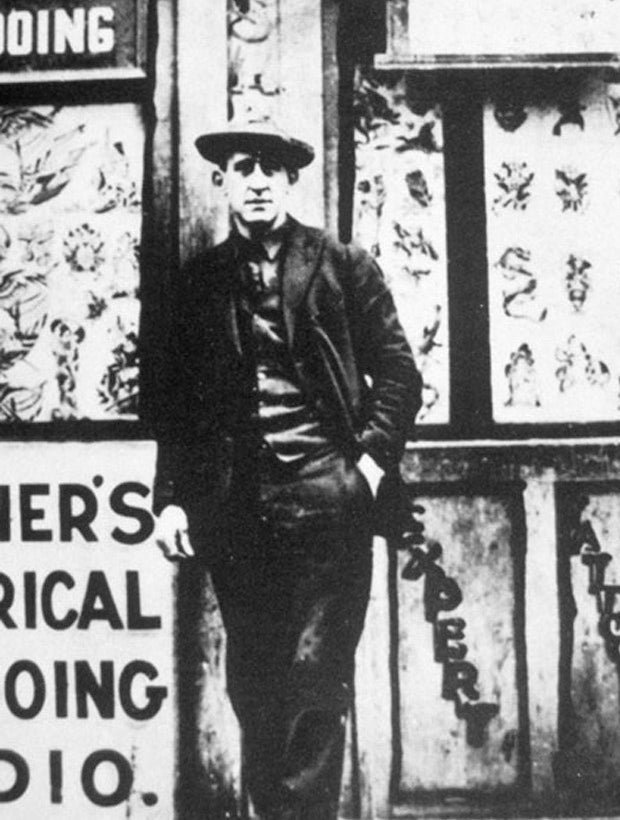
From about 1897 to 1899 Getchell partnered with Samuel O’Reilly at 5 Chatham Square.[1][3] They then split, and in 1899 Getchell opened at No. 11.[1] That address would later pass to O’Reilly and, after O’Reilly’s death, to Charlie Wagner, becoming one of the longest-running rooms in the trade.
A 1901 directory still lists Getchell at No. 11 and O’Reilly at No. 5; both men, the Tattoo Archive notes, were then living in Brooklyn.[1] Halls of Ink cites a New York Tribune profile of October 26, 1902, “A Tattooing ‘Artist,’” on Getchell’s Bowery business.[4] We have not yet pulled that article from the Library of Congress and so do not quote it.
The 1891 patent, a lawsuit and an inventor claim
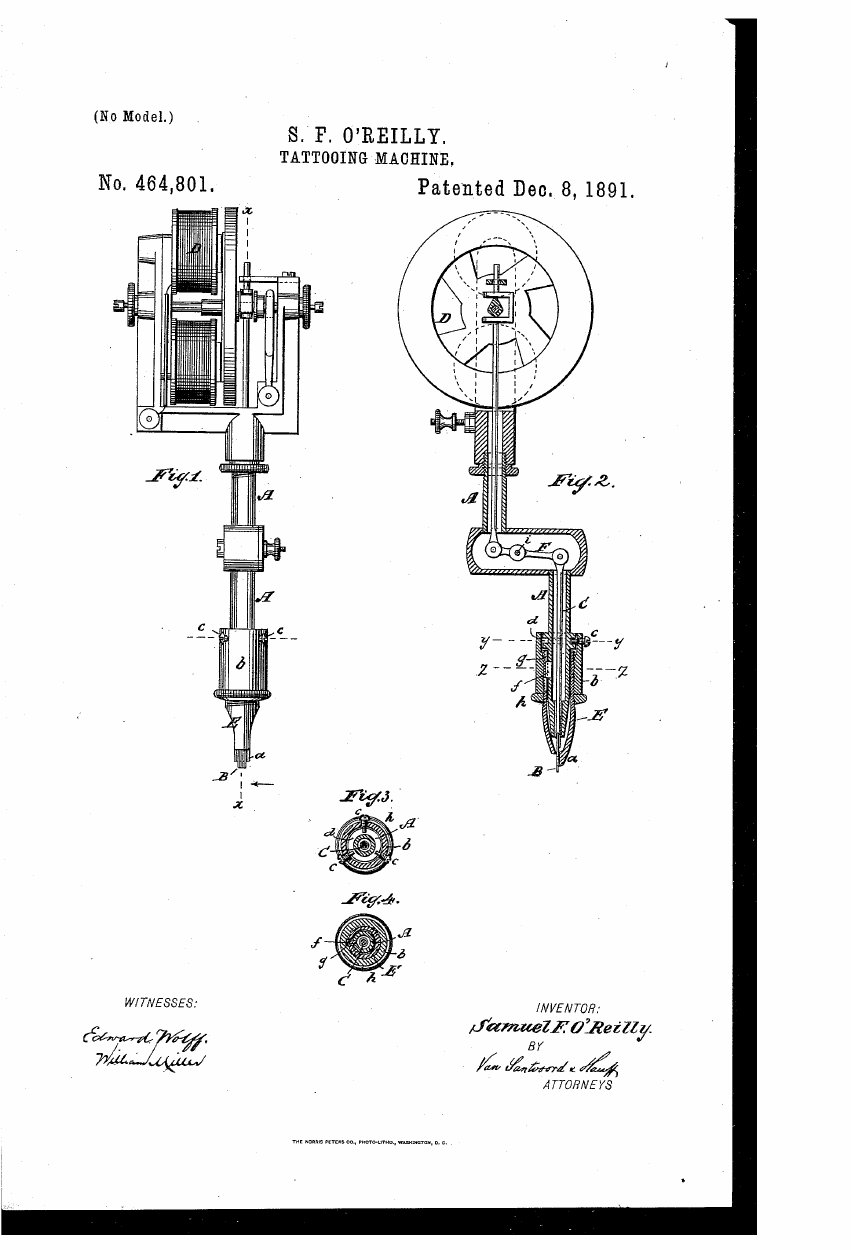
In April 1899 O’Reilly filed a bill of complaint in the U.S. Circuit Court for the Southern District of New York, Equity Case File O-7211, claiming that Getchell was selling machines that infringed U.S. Patent 464,801, the 1891 tattooing-machine patent.[1][2][6] The New York Times of February 6, 1900, reported the fight under the headline “Tattoo Artist at War.”[1] The outcome of the case is not clear in any source we have seen.
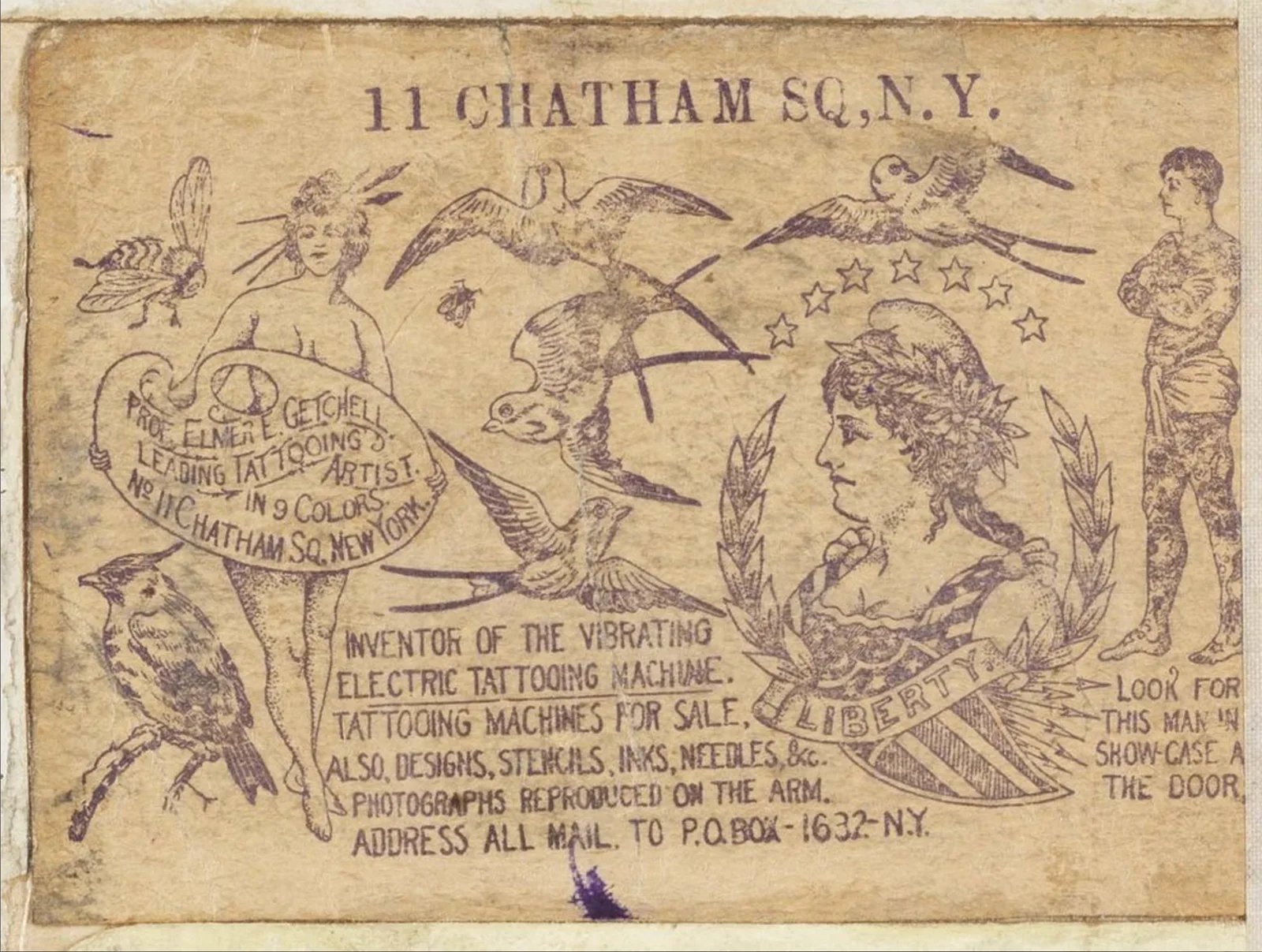
Getchell’s own card, shown above, does not mention O’Reilly. It calls Getchell the “inventor of the vibrating electric tattooing machine.” Bray & Co., cataloging a later card, has suggested that some in the trade regard Getchell as the true inventor of the vibrating coil machine used today, and that the lawsuit may have been hard to resolve because O’Reilly’s patented design was a different technology, closer to Edison’s motor-driven pen.[3] That is an auction-house opinion. It is not a patent.
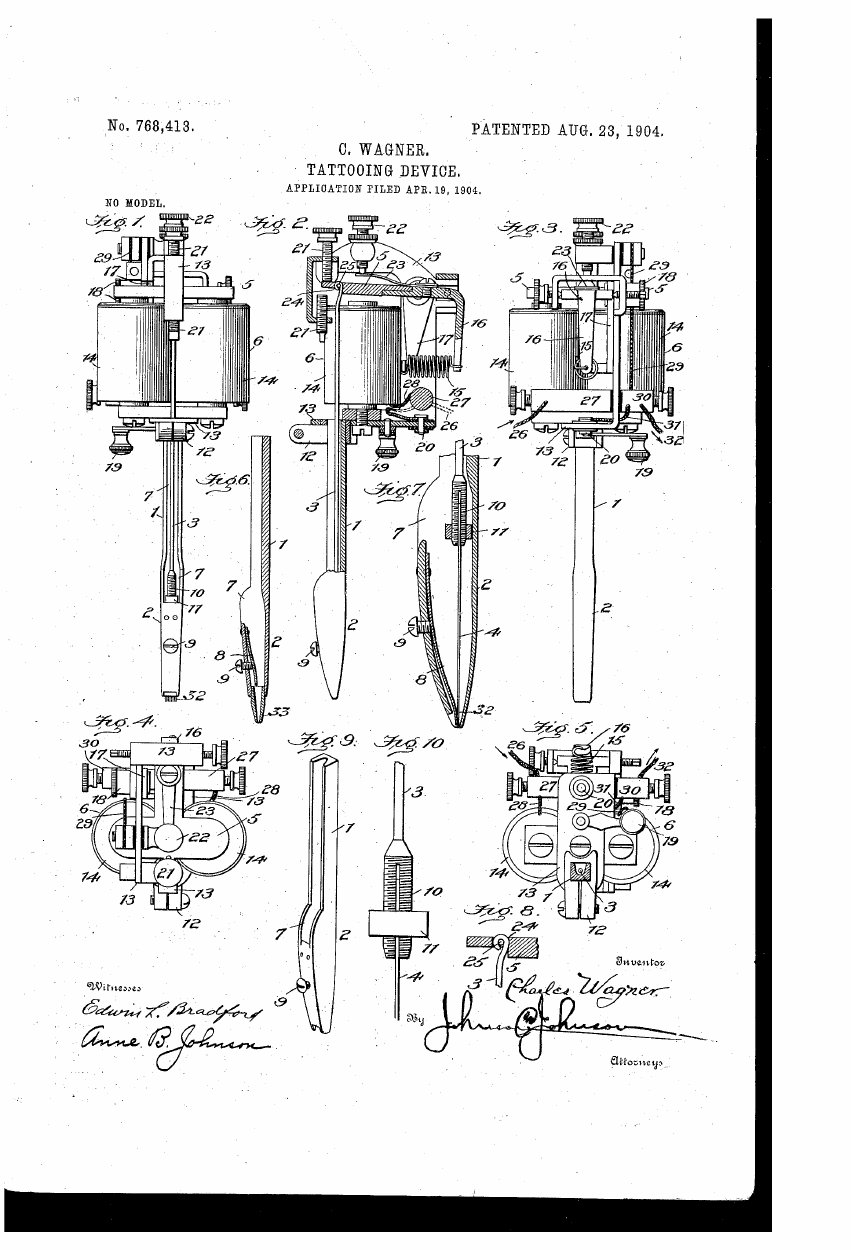
What the Patent Office did issue is easier to date. O’Reilly received the first U.S. tattoo-machine patent in 1891.[6] Charlie Wagner received U.S. Patent 768,413 in 1904 for a machine with its coils standing upright, in line with the tube — the first patented upright-coil design, and the layout most coil machines still follow.[7] Getchell’s card claim sits between those two dates. This page reports the claim, and the lawsuit, without promoting Getchell to “the” inventor.
Leaving No. 11
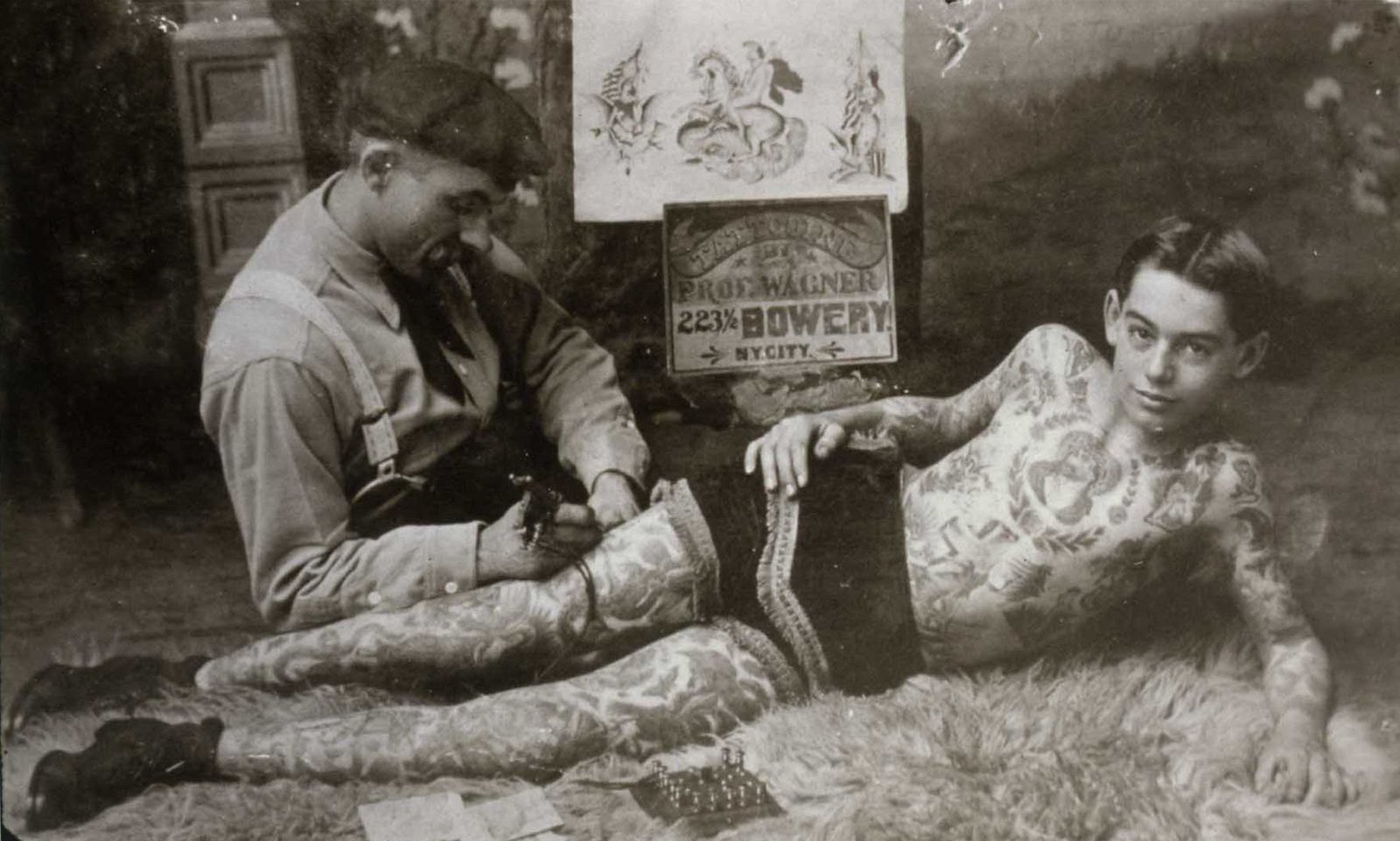
Getchell left New York around 1904. O’Reilly then moved into 11 Chatham Square, the room Getchell had opened.[1] After O’Reilly’s death in 1909, Wagner took it over. The later “Captain” card places Getchell in Washington, D.C., around 1927.[3] The Norfolk directories, if they name the same man, show a long second career in another navy town.[5]
11 Chatham Square is remembered today mainly as Wagner’s shop, and as O’Reilly’s last address. Getchell’s name belongs on the door first. The inventor line on his card is part of that history, not a substitute for the patents.
NYC Tattoo Shop is at 141 Canal St, a short walk from Chatham Square. The history here belongs to New York. We’re proud to work nearby.
Photo gallery
Getchell’s 11 Chatham Square card, from the NYC Tattoo Shop History Digital Archive. It dates the New York stay to the years between 1899 and about 1904.