
For more than half a century Charlie Wagner tattooed sailors, showgirls, dock workers and circus stars at the foot of the Bowery. He took over Samuel O’Reilly’s shop at 11 Chatham Square, patented the upright-coil machine layout most tattooers still use, and sold machines and flash to shops across the country.[2][3][1] This page gathers what the records actually show, what is still disputed, and the photographs that survive.
Quick facts
- Born
- c. 1875, Prešov, Austria-Hungary (1873 in one source)
- Died
- 1953, New York City
- Known as
- “Prof. Chas. Wagner,” “the Michelangelo of Tattooing”
- Shops
- 294 E. Houston St (c. 1899); 223½ Bowery (early 1900s); 11 Chatham Square (1908/09–1953); 4 Chatham Square (1913); 208 Bowery (supplies; 1913–1925)
- Patent
- U.S. 768,413, Aug 23, 1904
- Teacher
- Samuel O’Reilly
- Students
- Lew Alberts, Willie Moskowitz, Millie Hull
- Famous clients
- Betty Broadbent, Millie Hull, Mae Vandermark, Trixie Richardson, Andy Stuertz, Jack Tryon
From Prešov to the Lower East Side
The man New York papers would call the dean of the Bowery tattooers came to the city as a small child. The owner’s 2019 profile and the Swedish tattoo-history site Tatuteket both say he was born Charles Wiegner in 1875 in Prešov, a town in today’s eastern Slovakia that then belonged to Austria-Hungary, and that his family reached America around 1880, when he was about five.[7][4] The name was later Americanized to Wagner.[6]
His birth year is not fully settled. The Henry Ford’s catalog and most tattoo historians give 1875, while a 2017 exhibit label at the New-York Historical Society gave 1873.[11][16] We use 1875 here and flag the difference.
Wagner grew up on the Lower East Side among immigrant families, laborers and the street life of the old Fourth and Sixth Wards. Tatuteket reports that his father was probably a cooper, a barrel maker.[4] A 1933 newspaper dispatch summarized by the Tattoo History Atlas says he worked as a machinist and then as an artist before he ever picked up a tattoo needle.[6] That order matters. A machinist’s hands and an illustrator’s eye are exactly the two skills his later career would combine.
He told the writer Albert Parry how it began. Sometime in the late 1880s he saw the tattooed showman billed as Constantine at a dime museum on Grand Street, was so struck that he got tattooed himself, and set out to learn the craft.[29]
Learning the trade: O’Reilly, Houston Street and an 1899 court case
Most accounts agree Wagner began tattooing in the early 1890s. The Tattoo Archive dates his Bowery career from the 1890s to his death, more than fifty years in all, and newspaper reports from 1933, 1935 and 1945 each describe a career of forty-five to fifty-plus years, which points to a start around 1890 to 1893.[2][6]
His teacher is usually named as Samuel O’Reilly, who received the first U.S. patent for an electric tattoo machine in December 1891.[26][3] The 2016 historical marker at Chatham Square calls Wagner O’Reilly’s student. Other writers are more careful: the Tattoo History Atlas describes the apprenticeship as likely but not proven by any document, while the shop succession that followed is well recorded.[3][6]
Before Chatham Square, Wagner ran his own room. Tatuteket places it at 294 East Houston Street, and our 2019 profile dates the Houston Street shop to about 1899, when he was in his mid-twenties.[4][7] That same year, Tatuteket reports, he was taken to court after tattooing three Jewish boys whose parents objected. The charges were dropped once the boys said they had come in on their own and asked more than once.[4] We have not yet located the original 1899 newspaper report, so treat the details as secondhand. The episode is a reminder that New York had no age limit for tattooing at the time. As the Mariners’ Museum notes, a minor’s consent was enough.[5]
223½ Bowery and the tattooed boys
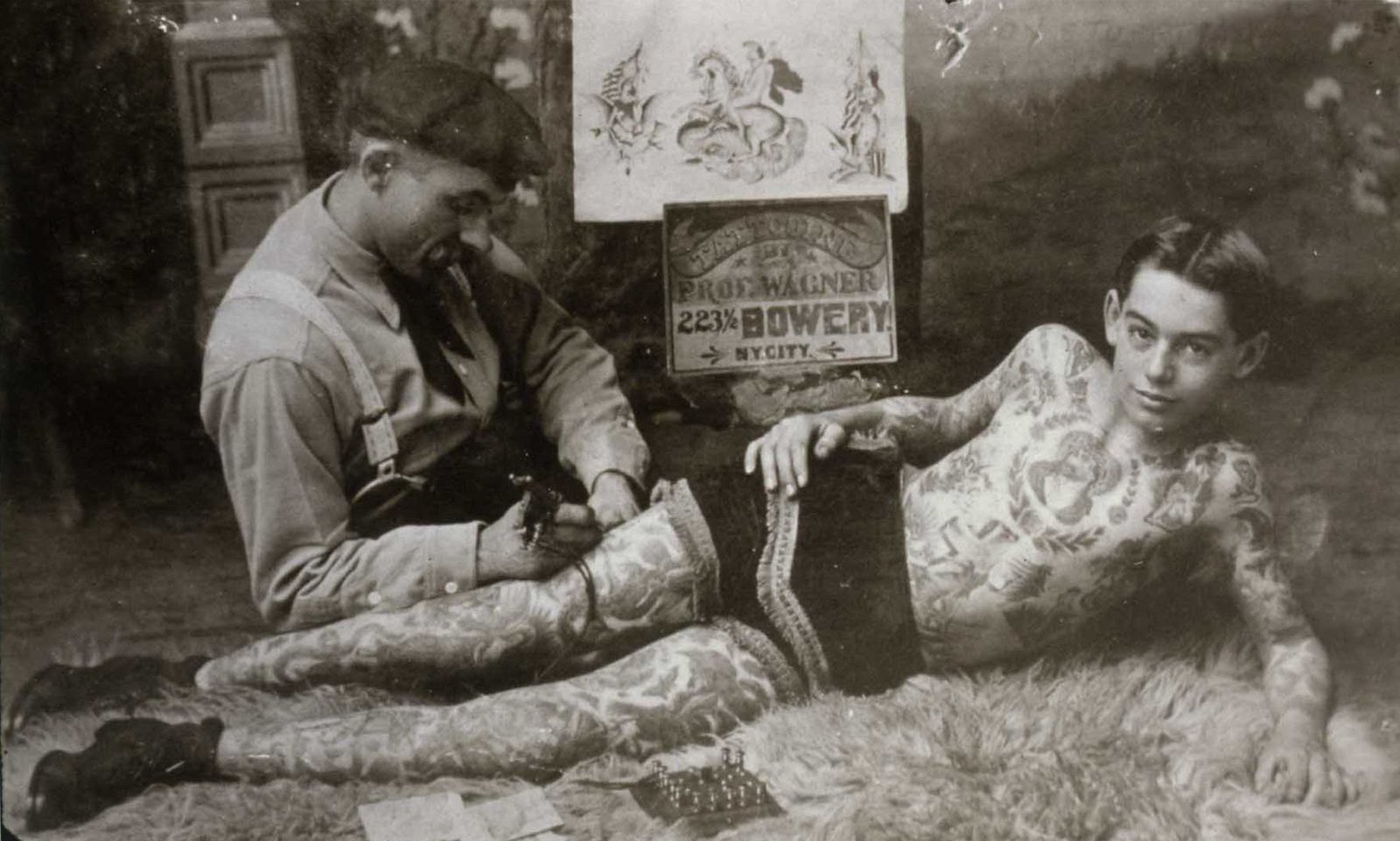
Around the turn of the century Wagner moved onto the Bowery itself. Tatuteket gives 223 Bowery. A promotional photograph in our archive, showing him at work on a teenage boy, carries a hand-lettered sign reading “Prof. Wagner, 223½ Bowery,” and the Mariners’ Museum found the same address on a complete print of that image.[4][5] The marker at Chatham Square also lists 223 Bowery among the addresses he rented.[3]
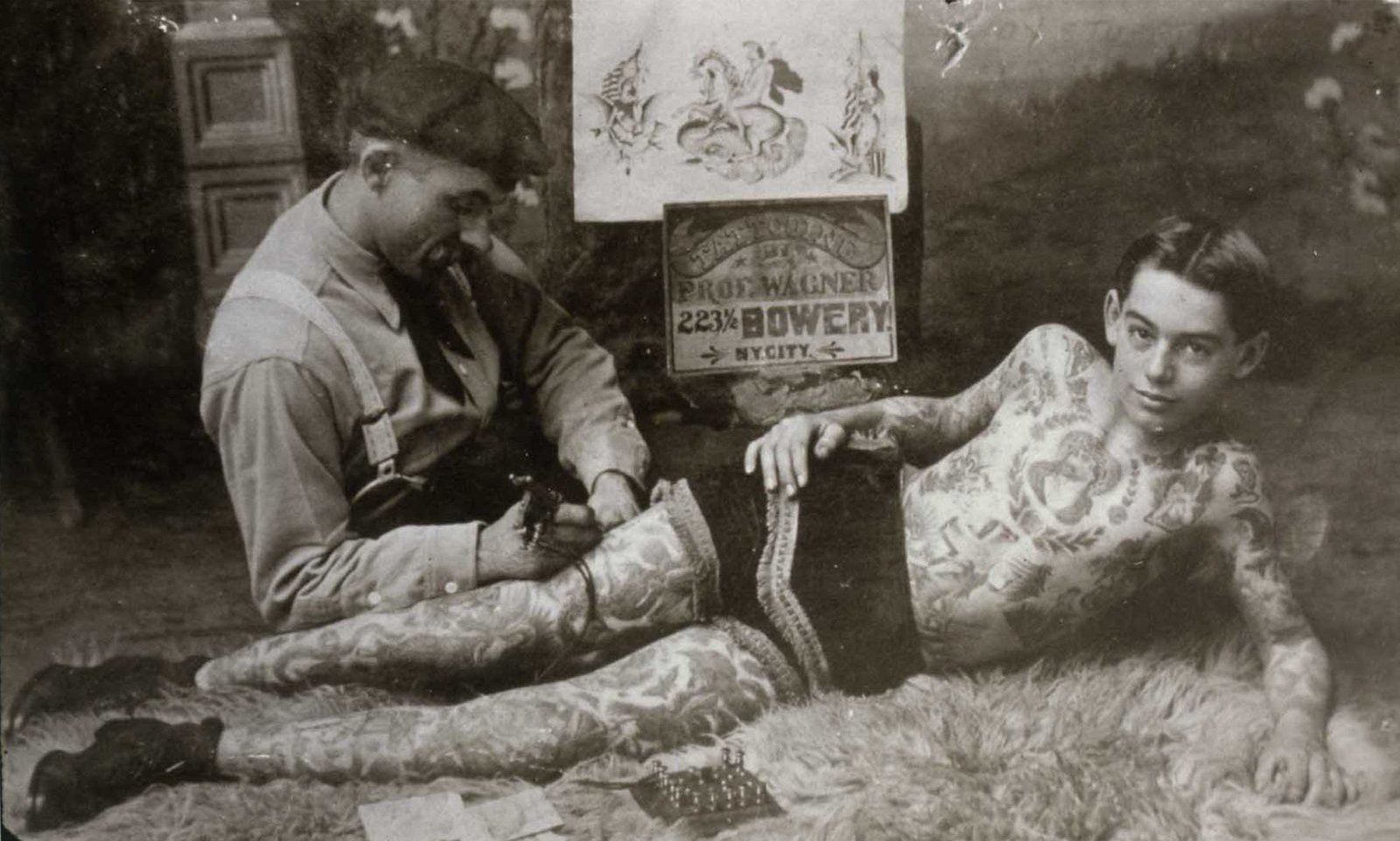
The boy is Andrew “Andy” Stuertz, an orphan from Philadelphia who came to New York in his early teens. According to the Mariners’ Museum, which owns another print of the photo, he agreed to let Wagner cover him from head to toe and then toured from about 1907 as “The Tattooed Boy,” with shows that included Barnum & Bailey.[5] He later became a tattooer himself in Norfolk, Virginia.[5]
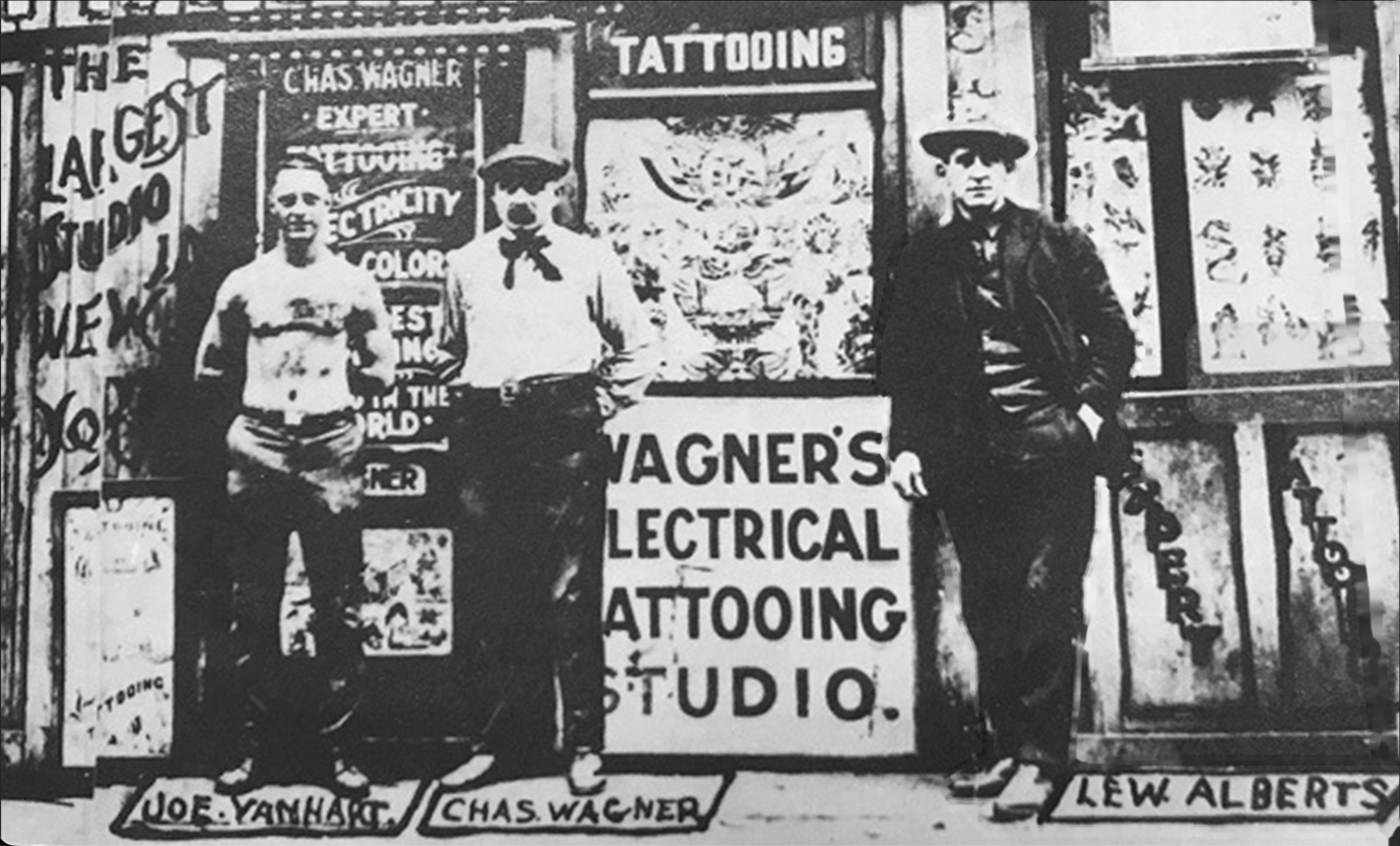
Stuertz was one of many. Wagner became the go-to artist for young people who wanted to earn a living as tattooed attractions. The museum’s research names Charles Craddock, Jack Tryon, Anthony Gallo and Wagner’s own brother Stephen among the young men he covered.[5] Tryon, a Michigan-born fire-eater and wire walker, was covered from neck to ankle by Wagner and Lew Alberts. A cabinet card from about 1905 shows him next to a hand-lettered card: “Tattooed by Wagner and Alberts, Chatham Sq. N.Y.” Billed as “the World’s Most Handsomely Tattooed Man,” he went on to tattoo for decades, ending up in San Antonio.[31][30]
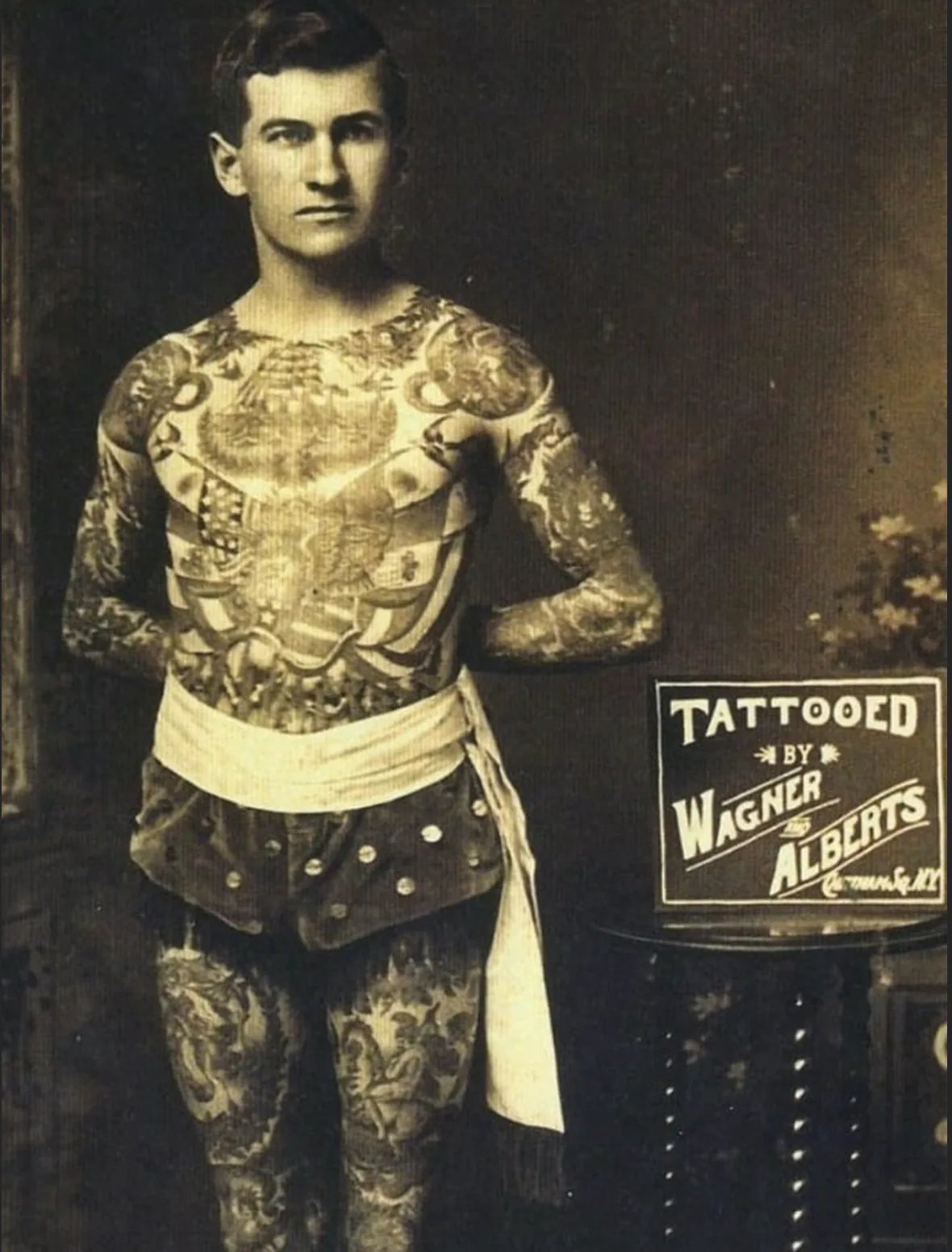
Tatuteket adds Grant “Shorty” Dubbs and calls Stephen, billed as “Adonis,” a half-brother.[4] The performers typically paid little or nothing. Their skin was the advertisement.[4]
The Mariners’ Museum also spotted a small piece of business history in these photos: on some copies the number 223½ has been painted over to read 208 Bowery, Wagner’s later address, which suggests he kept reprinting the same picture as a promotional card.[5]
The 1904 patent: the coil layout still in use
On April 19, 1904, Wagner filed an application for a “Tattooing Device,” and on August 23, 1904, he received U.S. Patent 768,413.[1] O’Reilly’s earlier machine had borrowed the rotary motor of Thomas Edison’s electric pen.[26] Wagner’s design used electromagnets instead, and the Tattoo Archive identifies it as the first patented tattoo machine with its coils standing upright, in line with the tube.[2] That arrangement became standard. Most coil machines built today still follow it.[2][3]
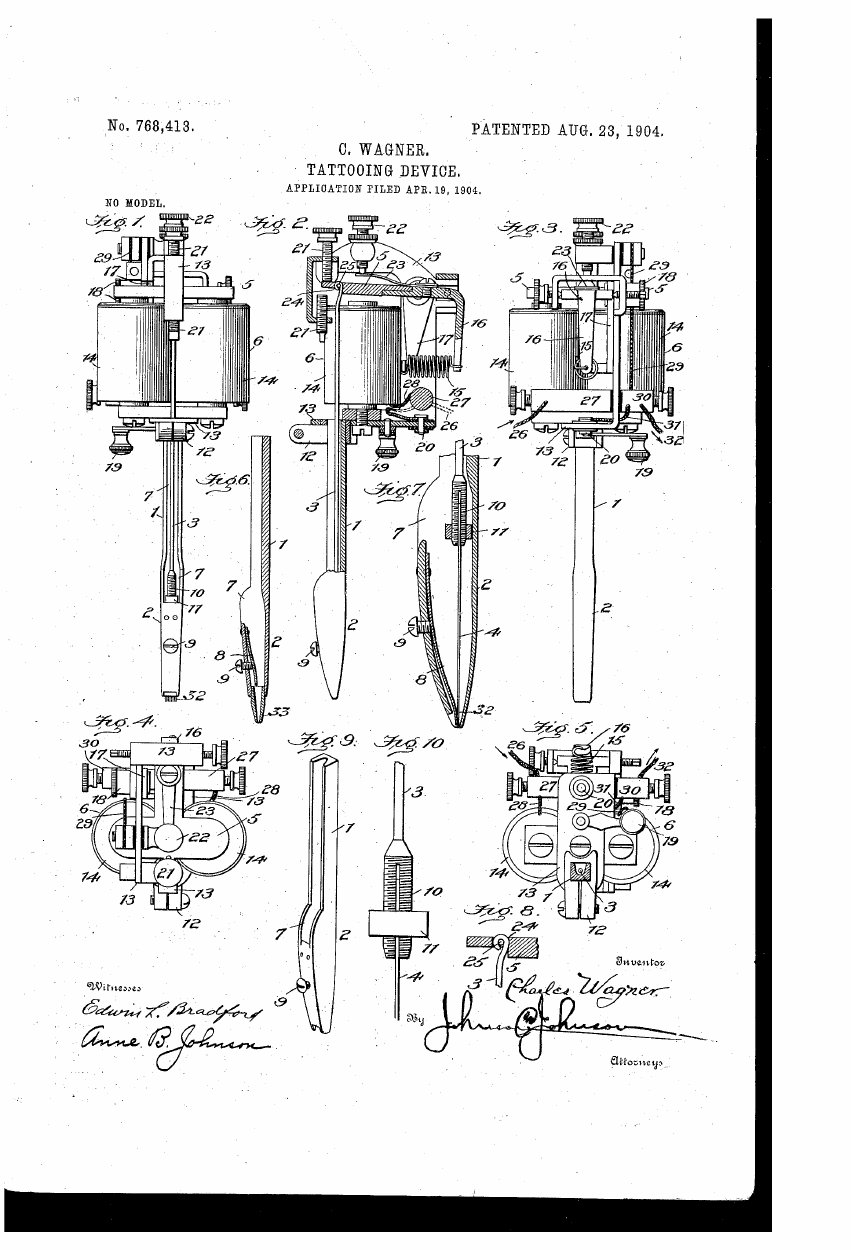
One signature on the paperwork links two Bowery legends. The application was witnessed by Albert M. Kurzman, the birth name of the flash designer known in the trade as Lew Alberts.[1][24] It is the earliest firm document tying the two men together. A cabinet card of Jack Tryon from about 1905, shown earlier on this page, advertises them as a team.[31]
Speed was the selling point. The Smithsonian estimates that a tattooer working by hand made two or three punctures a second, while an electric machine could make about fifty.[27] For performers who wanted full-body coverage, Wagner and O’Reilly before him marketed the machine as faster and less painful, according to Tatuteket.[4]
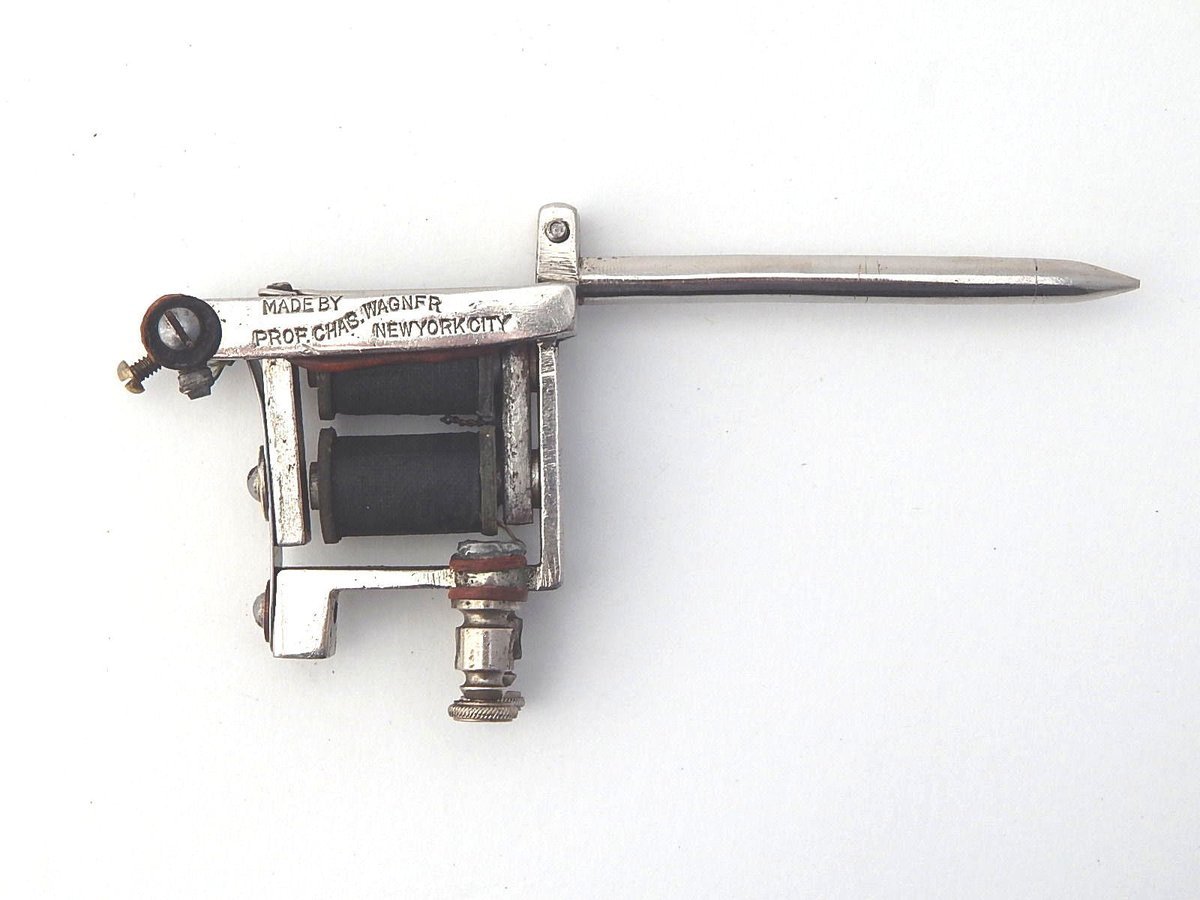
Strangely, no machine built exactly to the 1904 drawing is known to survive.[2] What does survive are later Wagner machines, like the one in our archive stamped “Made by Prof. Chas. Wagner, New York City.”
11 Chatham Square
Samuel O’Reilly worked at 5 Chatham Square for years and moved to No. 11 around 1904, after his former partner and courtroom rival Elmer Getchell left town.[8] Getchell, a Boston tattooer, had opened at No. 11 in 1899 after O’Reilly sued him over the 1891 patent, and his card there billed him as “inventor of the vibrating electric tattooing machine.”[8][34] When O’Reilly died after falling from a ladder while painting his house, Wagner took over the shop.[8][3] Sources disagree on the year. The Tattoo Archive, citing the Brooklyn Daily Eagle of May 1, 1909, and Wikipedia give April 29, 1909, while the marker and a New-York Historical Society blog post say 1908.[8][9][3][10] A 1935 Cleveland Press feature, as summarized by the Tattoo History Atlas, placed Wagner at No. 11 from 1908, which would fit an overlap.[6]
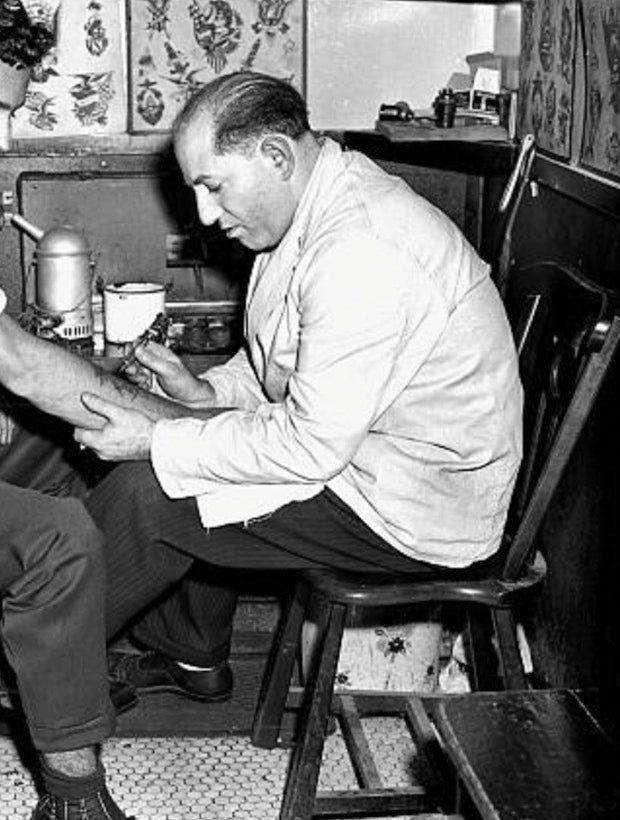
The shop was never a standalone parlor in the modern sense. Wagner worked from a space inside a barbershop, an arrangement common on the Bowery.[23] A postcard of about 1910 in the collection of The Henry Ford shows “Professor” Charlie Wagner’s Black Eye Barbershop and Tattoo Studio, and Bowery barbers of the era advertised a side service for brawlers: making black eyes look natural. Lew Alberts printed the same offer on his card.[11][6]
He stayed at 11 Chatham Square for the rest of his life, about four and a half decades.[3][2] Today the address is 16 Bowery, where a window marker calls the corner the “Birthplace of Modern Tattooing!”[3]
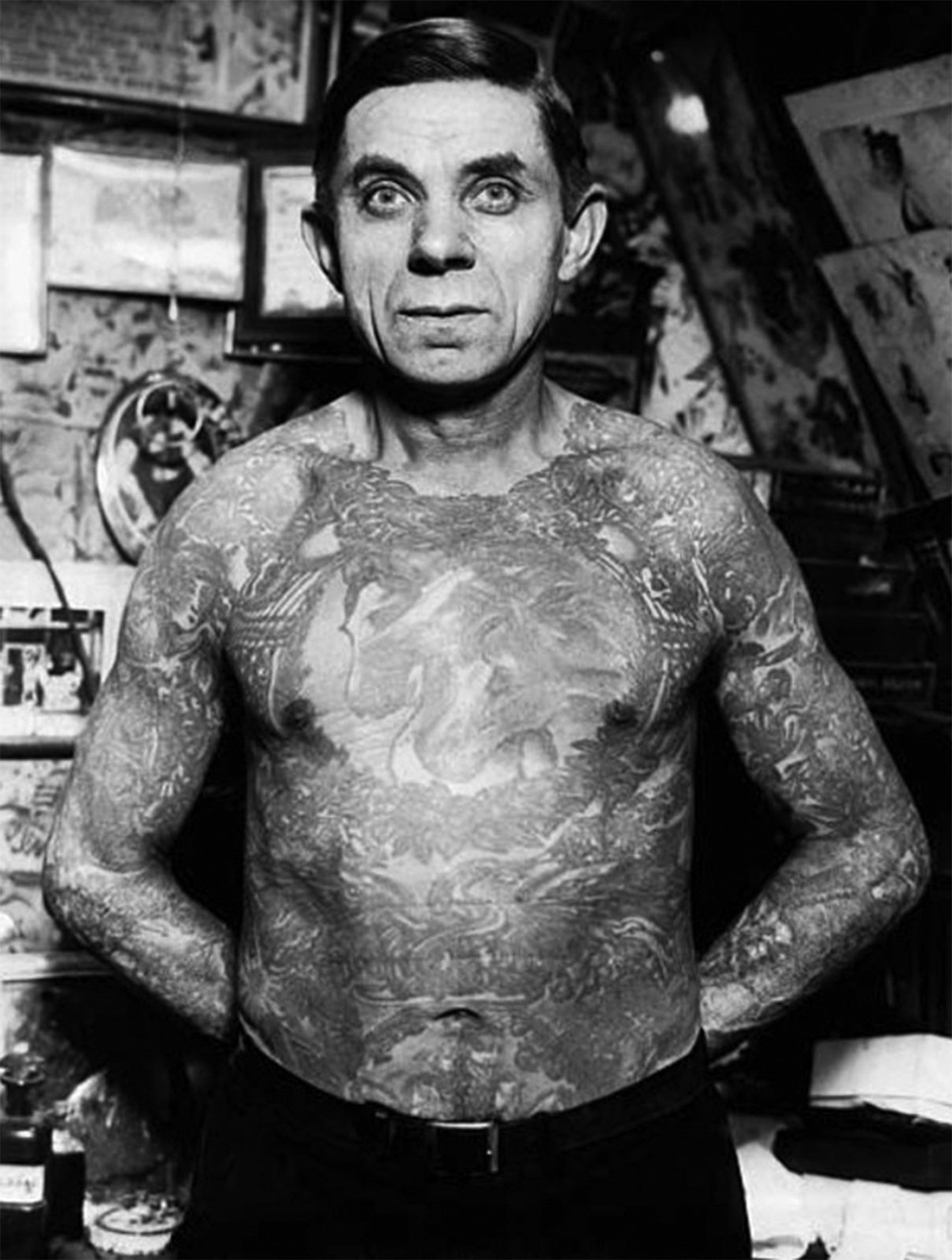
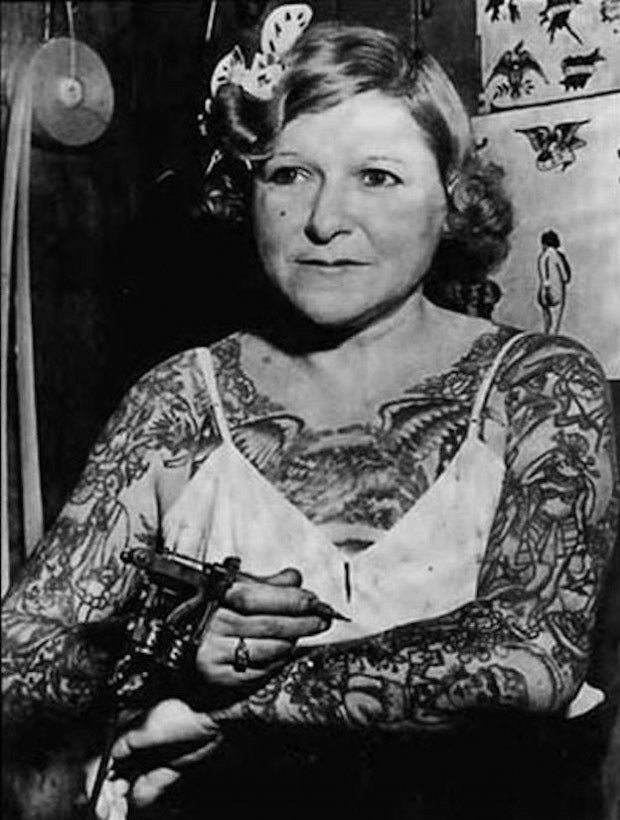
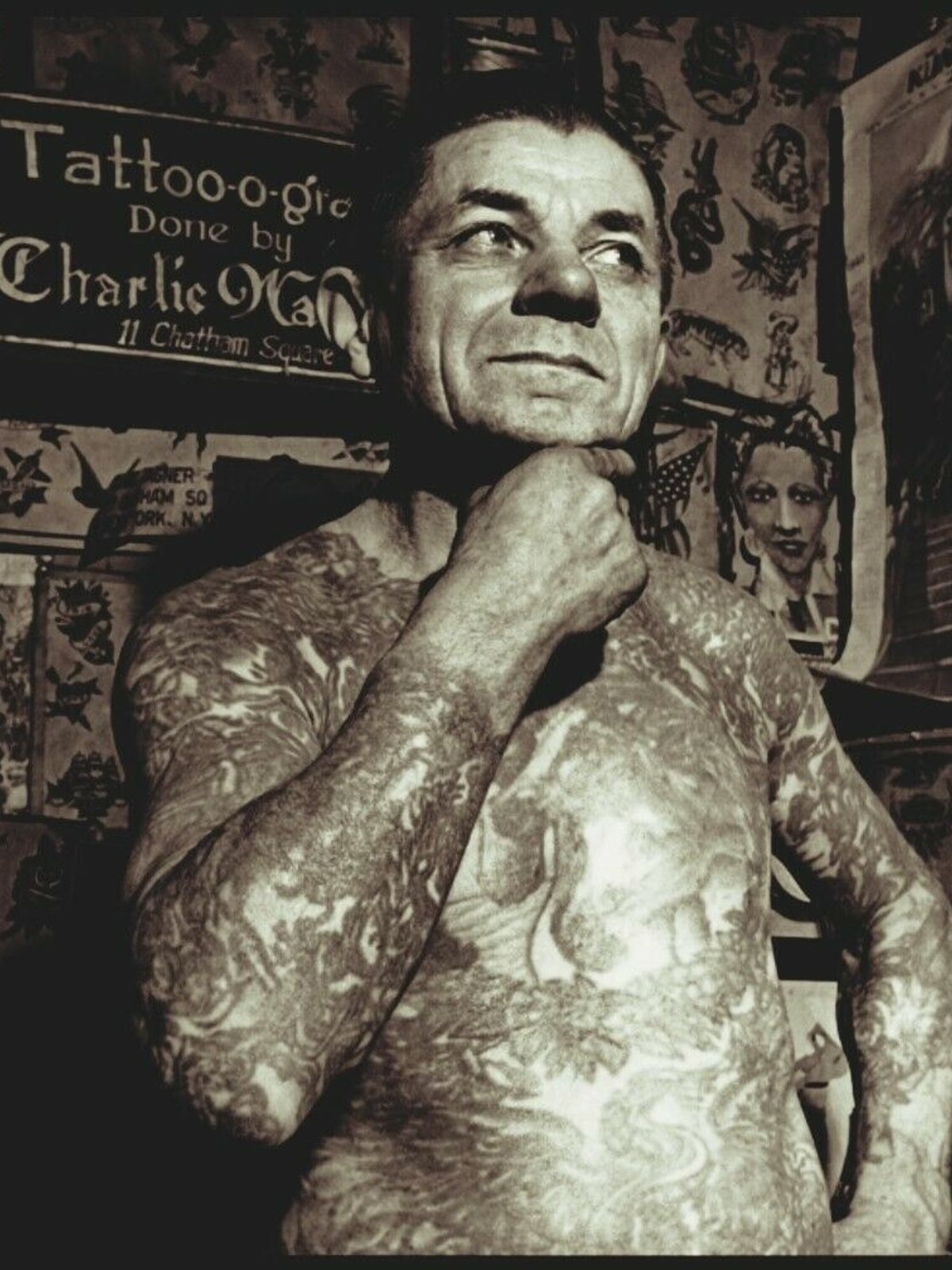
Wagner himself was heavily tattooed. Our 2019 profile says he covered his whole body except his face, and his studio photos, like the portrait at the top of this page, show the work running from wrists to waist.[7]
The supply business at 208 Bowery
Wagner never kept to a single shop. Over his career he worked from several addresses around the Bowery and Chatham Square, sometimes more than one at once: 294 East Houston Street around 1899, 223½ Bowery in the early 1900s, 11 Chatham Square from about 1908–09 until 1953, 4 Chatham Square (listed in 1913) and 208 Bowery (listed in 1913, still on his letterhead in 1925).[4][7][5][6][2]
Wagner did not just tattoo. He sold the tools. By 1913, a city directory cited by the Tattoo History Atlas put him at three addresses in the same year: 208 Bowery plus Nos. 4 and 11 on Chatham Square.[6] His business card in our archive spells out the offer: electric tattooing machines for sale, plus designs, inks, needles and stencils, “1000 designs to select from” and special designs made to order. It gives the address as 208 Bowery, opposite Rivington Street, and notes that he was “formerly of Bowery & Chatham Sq.”
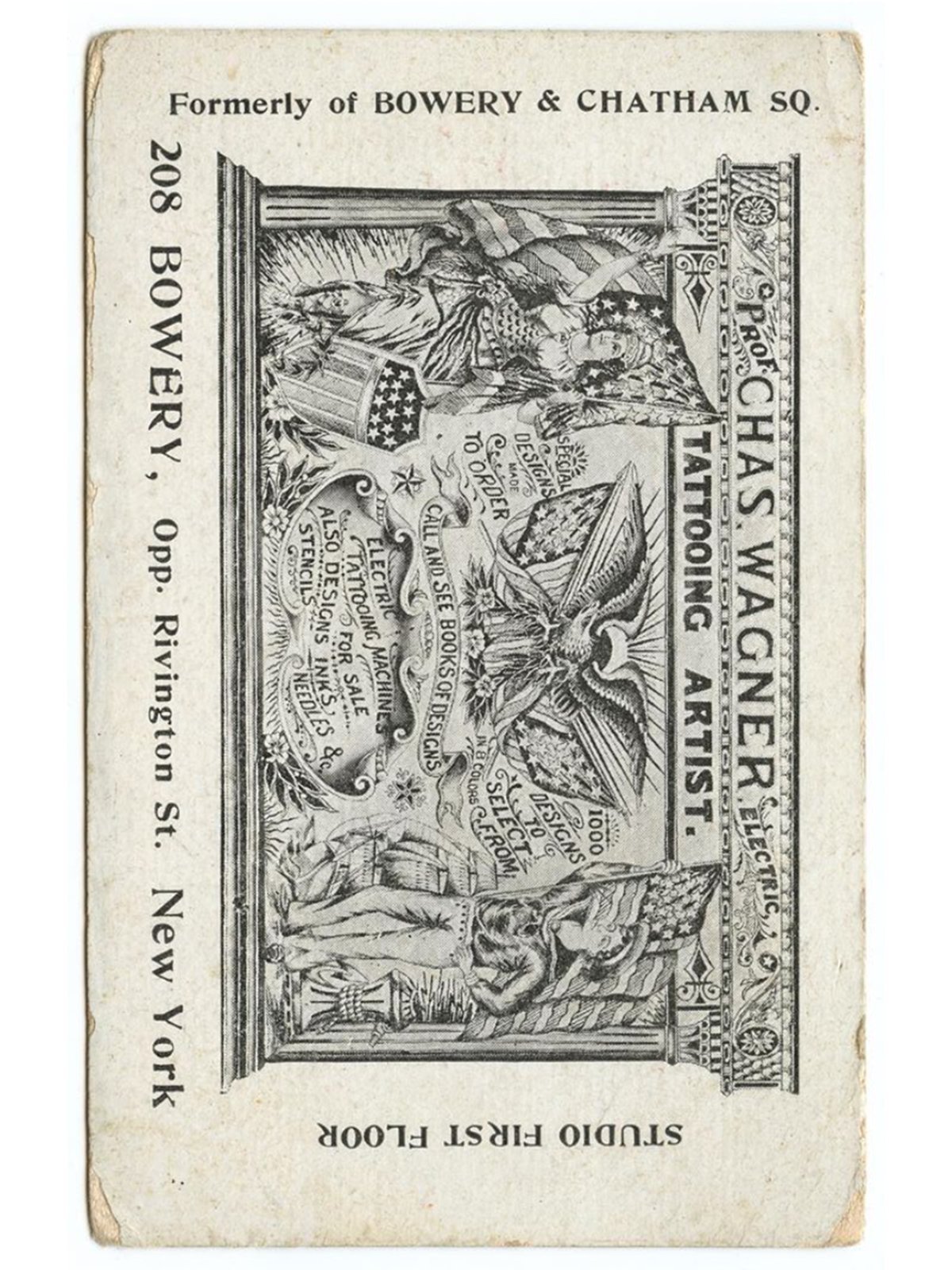
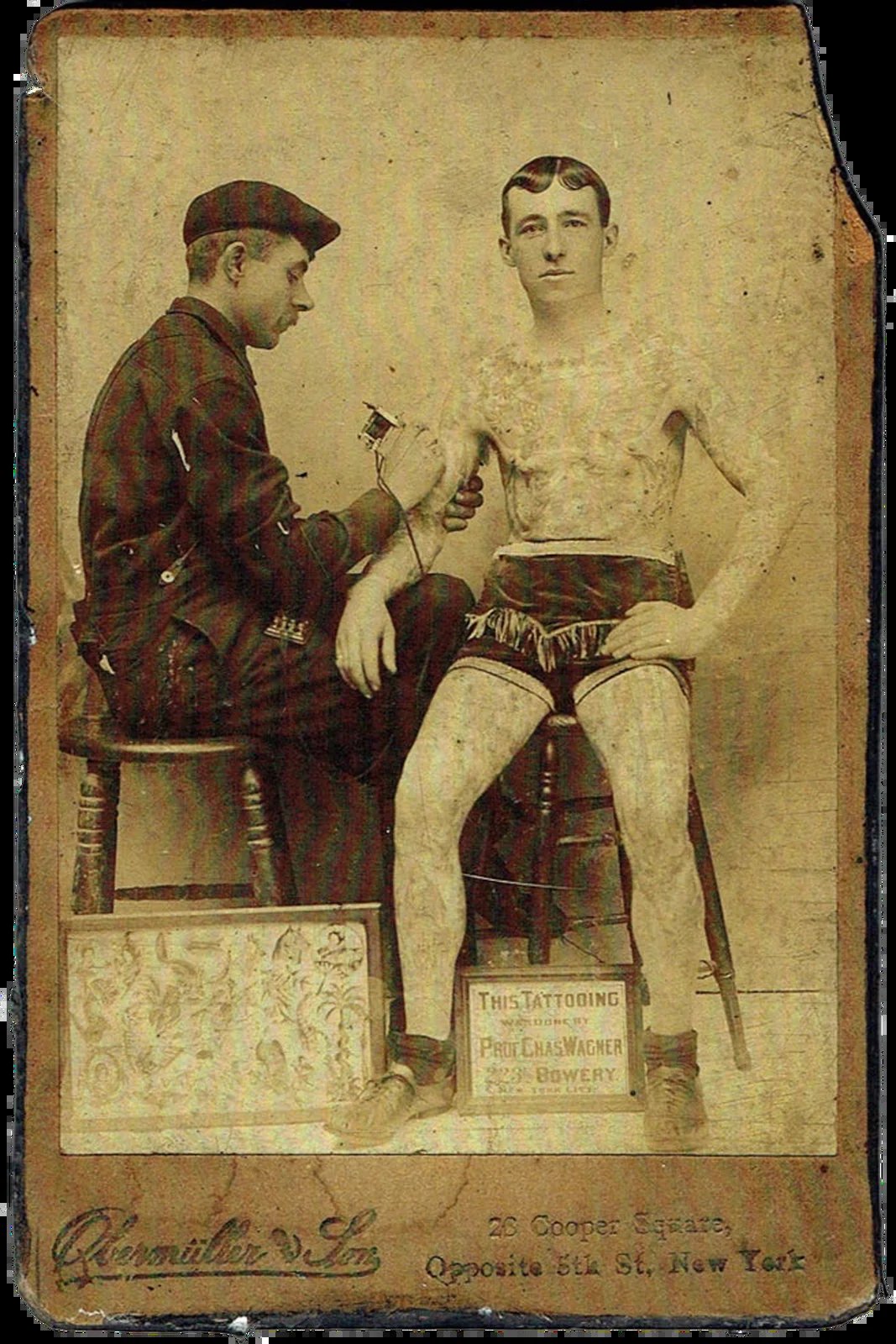
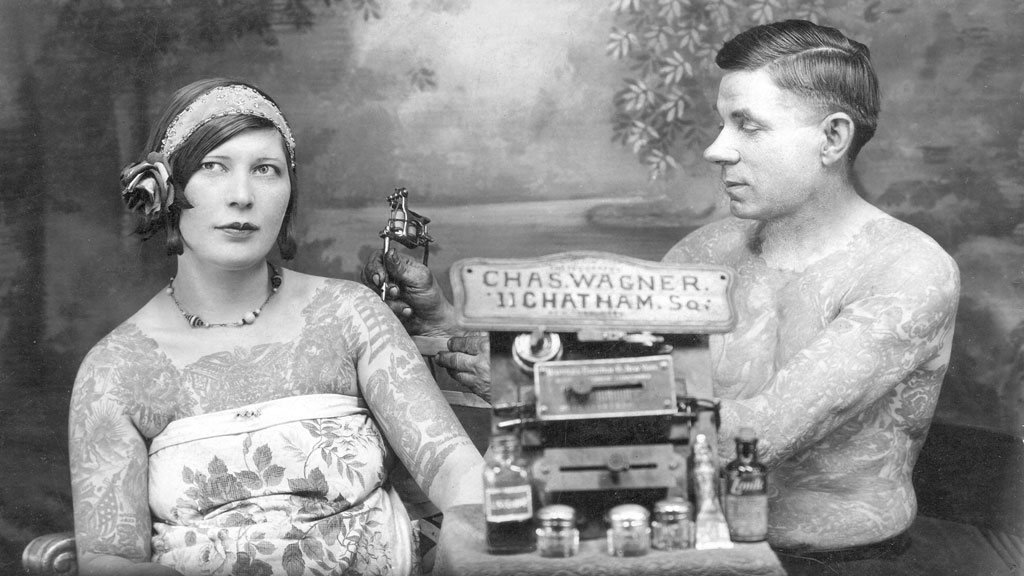
Both images: From the NYC Tattoo Shop History Digital Archive. The studio photograph carries the mount of the photographers Obermüller & Son, 26 Cooper Square, opposite 5th Street (their studio, not Wagner’s shop), and a sign reading “This tattooing was done by Prof. Chas. Wagner, 223½ Bowery.”
The Tattoo Archive found one of his supply price lists, mailed to the tattooer Fred Marquand in the 1920s. It was a plain mimeographed sheet with no pictures, a few gray flash samples tucked inside, far plainer than the illustrated catalogs other suppliers mailed out.[2] In a 1925 letter, signed “Prof. Chas. Wagner, 208 Bowery, N.Y. City,” Wagner told a customer he didn’t need a fancy catalog, because he alone held a U.S. patent on his machines.[2] The archive credits the machinist Bill Jones with helping him build many of them.[2]
Exactly how far his goods traveled is hard to measure. A 1933 newspaper dispatch claimed that twenty thousand sailors wore his spread-eagle chest design and that three-quarters of the tattooers in the world’s big ports had learned from him.[6] That was a reporter repeating a showman’s boast, and it should be read that way. What is certain is that he became, in Tatuteket’s words, a supplier to many American and British tattooers.[4]
Making the stars of the sideshow
The Tattoo Archive says Wagner tattooed about fifty professional attractions over his career.[2] Some of the best known:
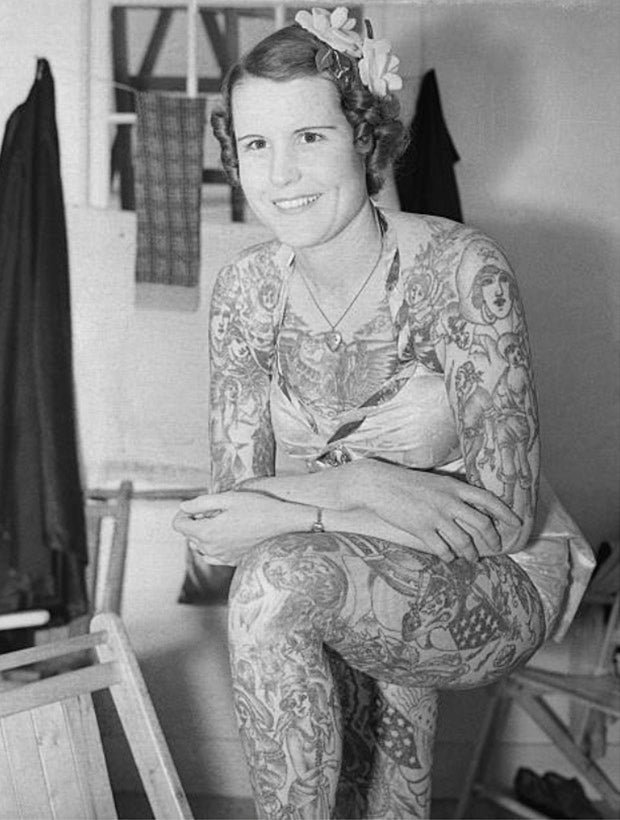
- Betty Broadbent. Starting in 1926 or 1927 (sources differ), Wagner and Joe Van Hart covered her over about two years. Wikipedia counts more than 565 designs and adds Tony Rhineagear and Red Gibbons to the team. She became one of the most photographed tattooed women of the century and later a tattooer herself.[18][19][6]
- Mildred “Millie” Hull. A former dancer whom Wagner tattooed and then trained. She went on to run her own room at 16 Bowery.[3][23]
- Mae Vandermark. A Pennsylvania stenographer who came to New York in 1924. A fellow performer brought her to Wagner, and as “Miss Artorio” she went on to the Ringling show. A 1927 report put the price of her suit at $130.[20][21]
- Trixie Richardson. A bobbed-hair flapper whom Wagner billed in 1924 promo photos as “Tattooed by Prof. Chas. Wagner, 11 Chatham Sq.”[32] Sunny Buick credits her and Wagner with the three-quarter-sleeve look later worn by Broadbent and Vandermark.[22] She became a tattooer herself. Parry wrote that in the summer of 1925 alone she put some 10,000 butterflies, forget-me-nots and other small designs on women along the New Jersey beaches.[29][33]
- Clara Clark, Charles Craddock, Joseph Cook and many others named in the Tattoo Archive’s list.[2]
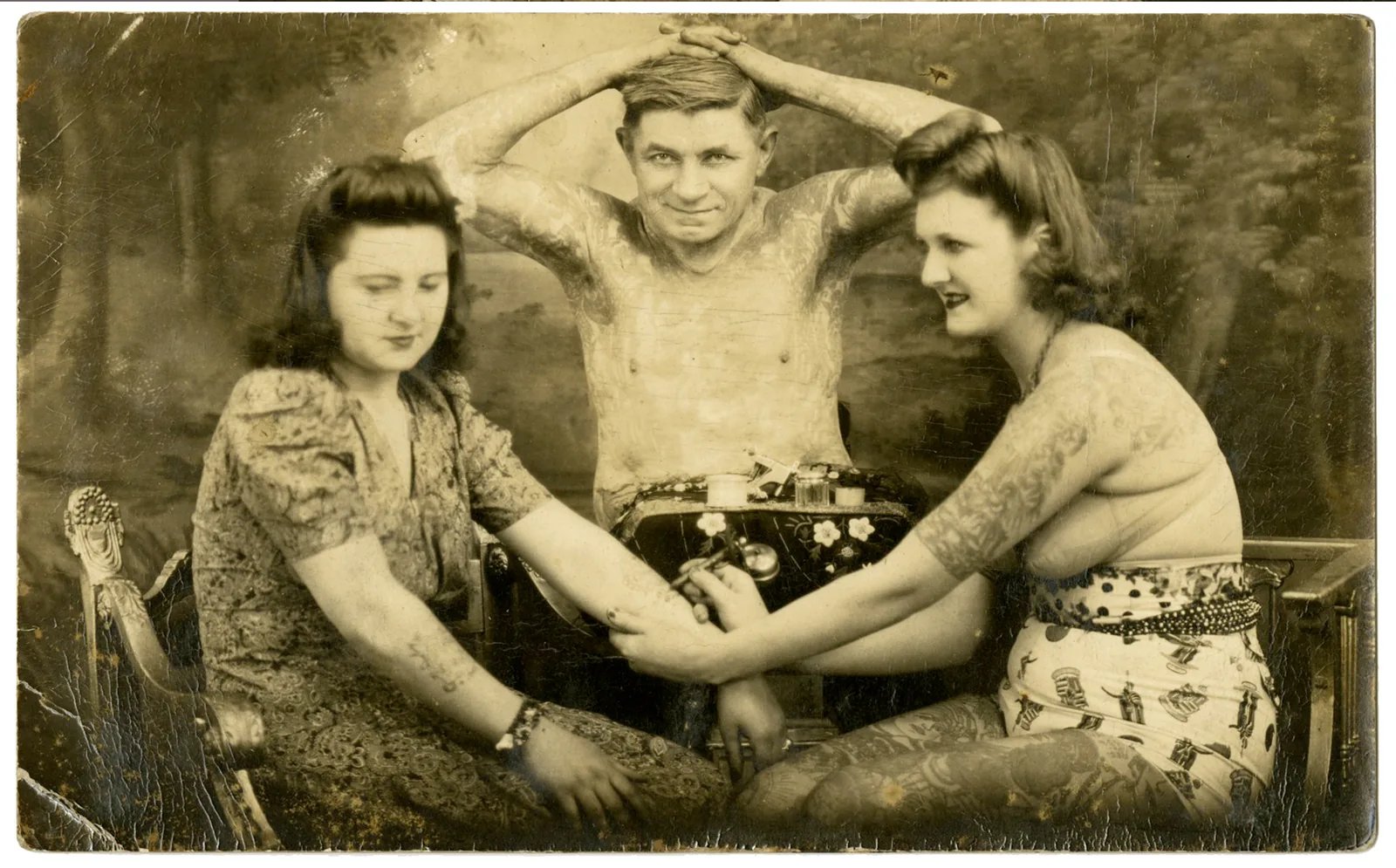
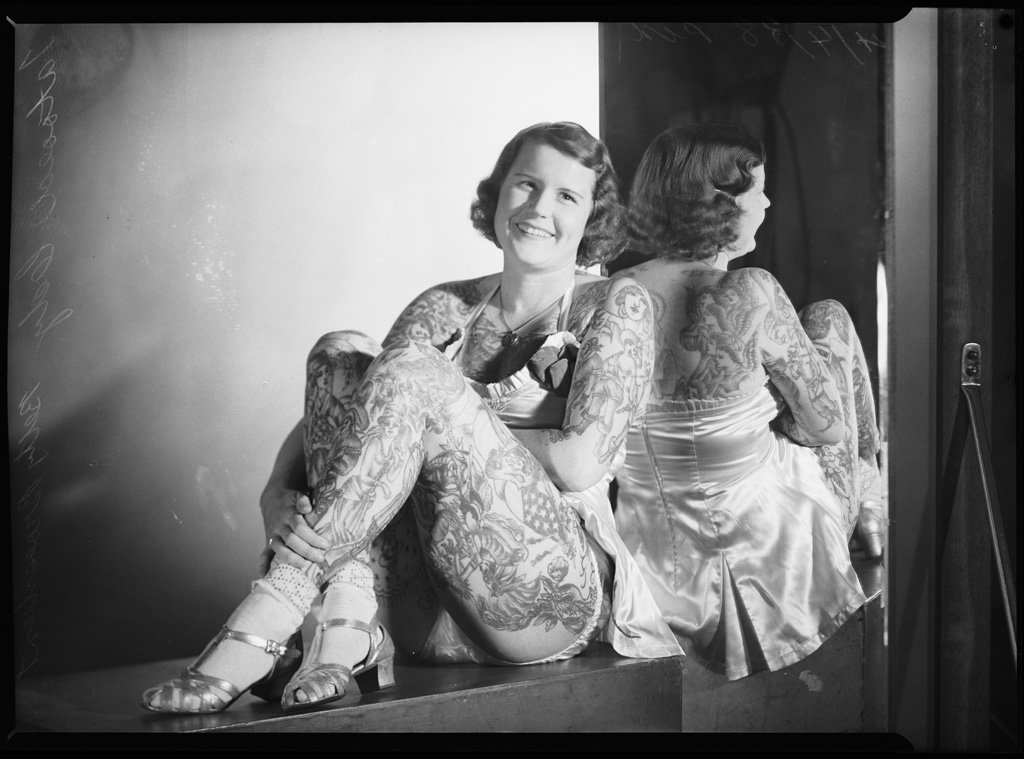
One attribution should be handled with care. Older sources say Wagner and O’Reilly tattooed Irene Woodward, the “original tattooed lady,” but she debuted in 1882, when Wagner was still a child.[28] We leave her off his list.
Dimes, quarters and the Depression
Wagner was famous for cheap work. Stanley Moskowitz, interviewed for Michael McCabe’s 1997 book New York City Tattoo, recalled that in the 1930s Wagner still charged 10 and 25 cents for designs that cost a dollar down the street. Bill Jones claimed to have seen jugs full of dimes and quarters in Wagner’s room.[12]
The Great Depression hit him hard. A long-told story says he lost a small fortune in the 1929 crash and ended up standing at his door to pull in customers. The Tattoo Archive labels this tattoo legend, and the Tattoo History Atlas says no financial record backs it.[2][6] Tatuteket accepts it.[4] A catalog essay by historian Carmen Nyssen describes the Wagner of 1935 asking for coffee money outside his shop.[13] However bad the decade was, he kept working and kept being written about. In 1933 Parry described his sign spelled “Tat-2-ing” and a semi-nude tattooed mannequin in the window that was sometimes rented out for parties.[29] A 1936 Life photo story on Bowery tattooing included his work.[35]
“Eventually you will buy frome me as I am the only one having a U.S. patent tattooing machine…”
Charlie Wagner, in a 1925 letter quoted by the Tattoo Archive (spelling as written)[2]
Students and the Bowery circle
Wagner sat at the center of a small, crowded world. His circle included:
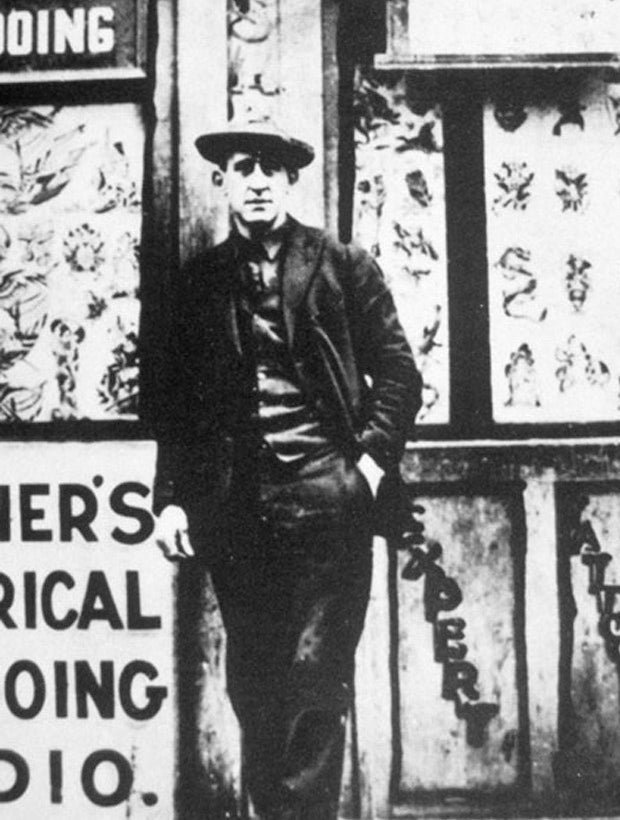
- Lew Alberts. The flash designer witnessed the 1904 patent and worked with Wagner at Chatham Square for several years. Their joint sign, “Tattooed by Wagner and Alberts,” appears on Jack Tryon’s card.[31] A parlor photo in our archive shows an “Alberts & Hicks” sign hanging among Wagner’s own.[1][24]
- Willie Moskowitz. A Russian-born barber, he learned tattooing from his friend Wagner and set up beneath his Bowery barbershop. His sons Stanley and Walter carried the trade on after the 1961 ban.[25][3]
- Millie Hull. New York’s best-known woman tattooer, trained by Wagner.[3]
- Bob Wicks. The young tattooer painted carnival banners and spent time at Wagner’s shop.[15]
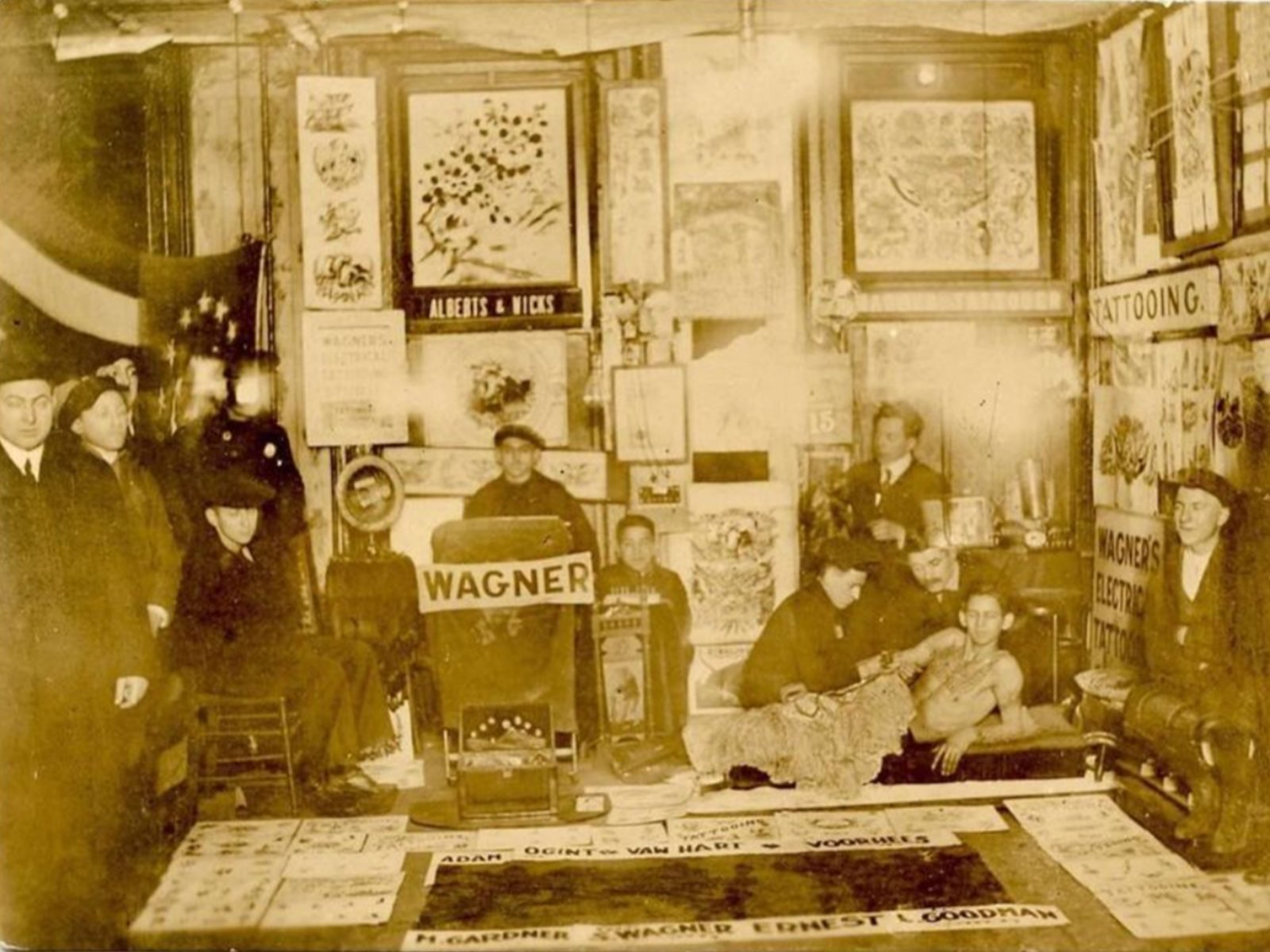
The banner names in that photo are a research lead we are still following. Joe Van Hart is documented as Wagner’s partner on Betty Broadbent.[18] We have not yet confirmed who Hicks, Gardner, Goodman and Voorhees were.
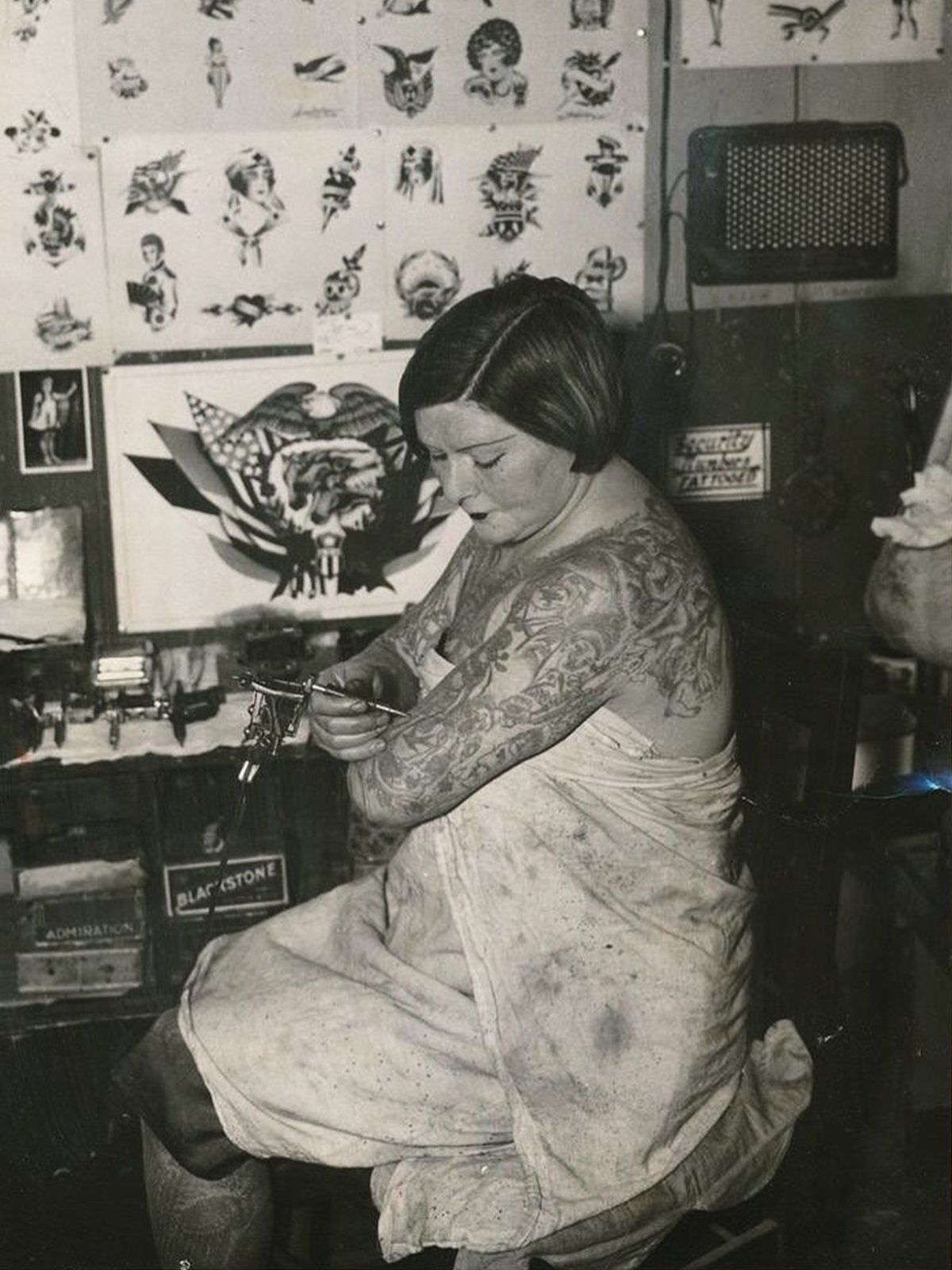
World War II and a $10 fine
War brought customers back to the Bowery, and with them a new kind of job. The Navy rejected recruits with nude tattoos, so tattooers spent the war years adding swimsuits and dresses to old pin-ups.[14][15] In 1944 Wagner was hauled into Magistrate’s Court for breaking the sanitary code. His defense, according to the National WWII Museum, was that he was doing his patriotic duty by putting clothes on nude figures so would-be sailors could pass inspection. The court fined him $10 and told him to clean up the shop.[14]
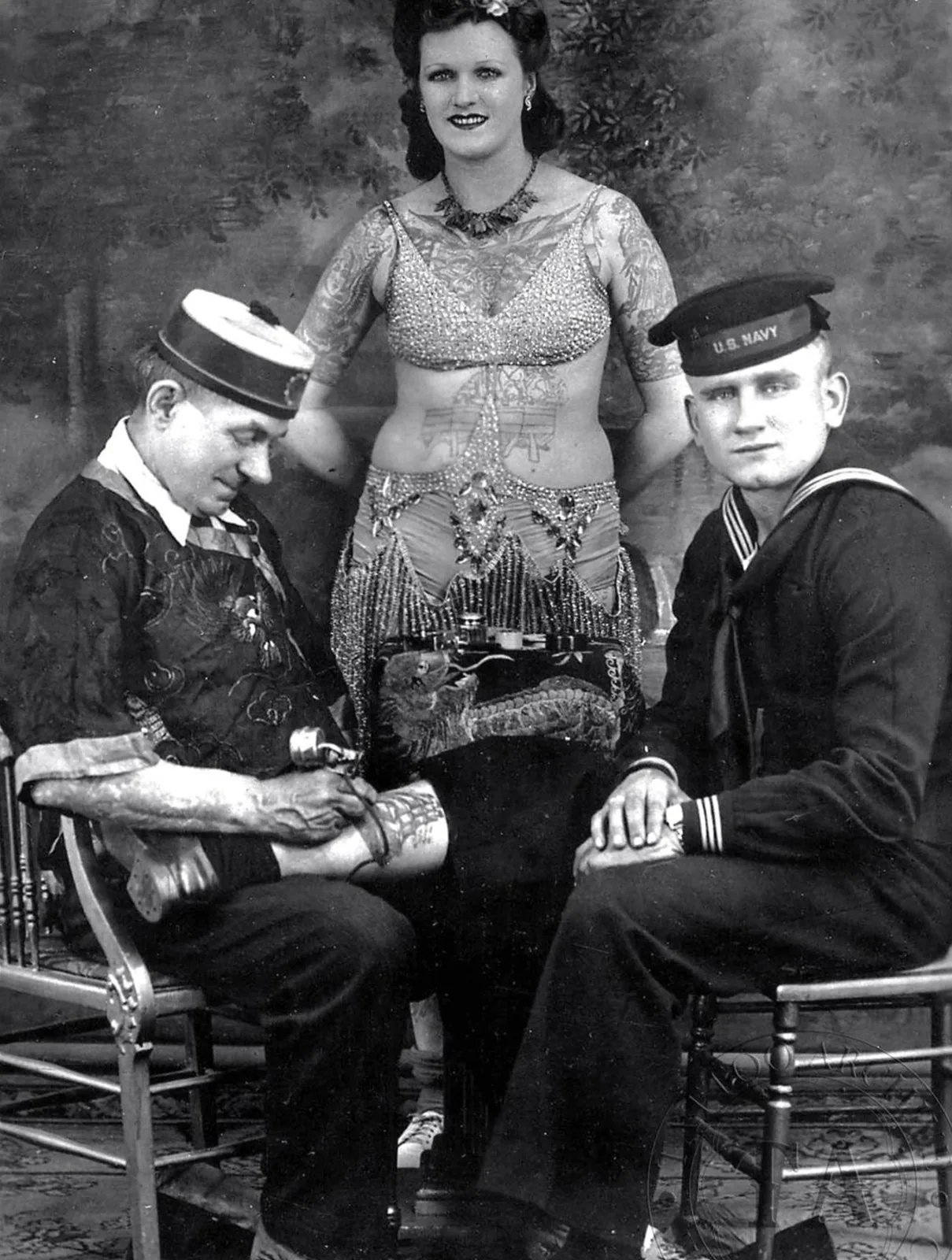
The case hinted at the future. Health officials were already watching the city’s tattoo shops. Eight years after Wagner died, the Board of Health banned tattooing in New York outright.[3]
Last years and legacy
Wagner kept working at 11 Chatham Square until his death in 1953.[3][2] The exact date isn’t settled in the sources we checked.[6] The press called him “Professor,” the “Michelangelo of Tattooing,” and after his death “Dad” Wagner.[2][3][6]
His mark on the trade is everywhere. The coil layout he patented is still the standard, the flash that moved through his supply business helped set the look of American traditional, and many of the performers he covered went on to tattoo.[2][4][5] In 2016 the Bowery Alliance of Neighbors put up a marker at his old corner naming him and O’Reilly the fathers of modern tattooing.[3] A year later the New-York Historical Society’s Tattooed New York exhibition showed a 1939 painting by Ace Harlyn of Wagner tattooing Millie Hull, along with a papier-mâché figure from his shop.[16][17]
NYC Tattoo Shop is at 141 Canal St, a short walk from where Wagner worked. The history here belongs to New York. We’re proud to work nearby.
Photo gallery
Photographs, cards and documents from Wagner’s career. Archive photos: From the NYC Tattoo Shop History Digital Archive. Patent drawing: public domain.