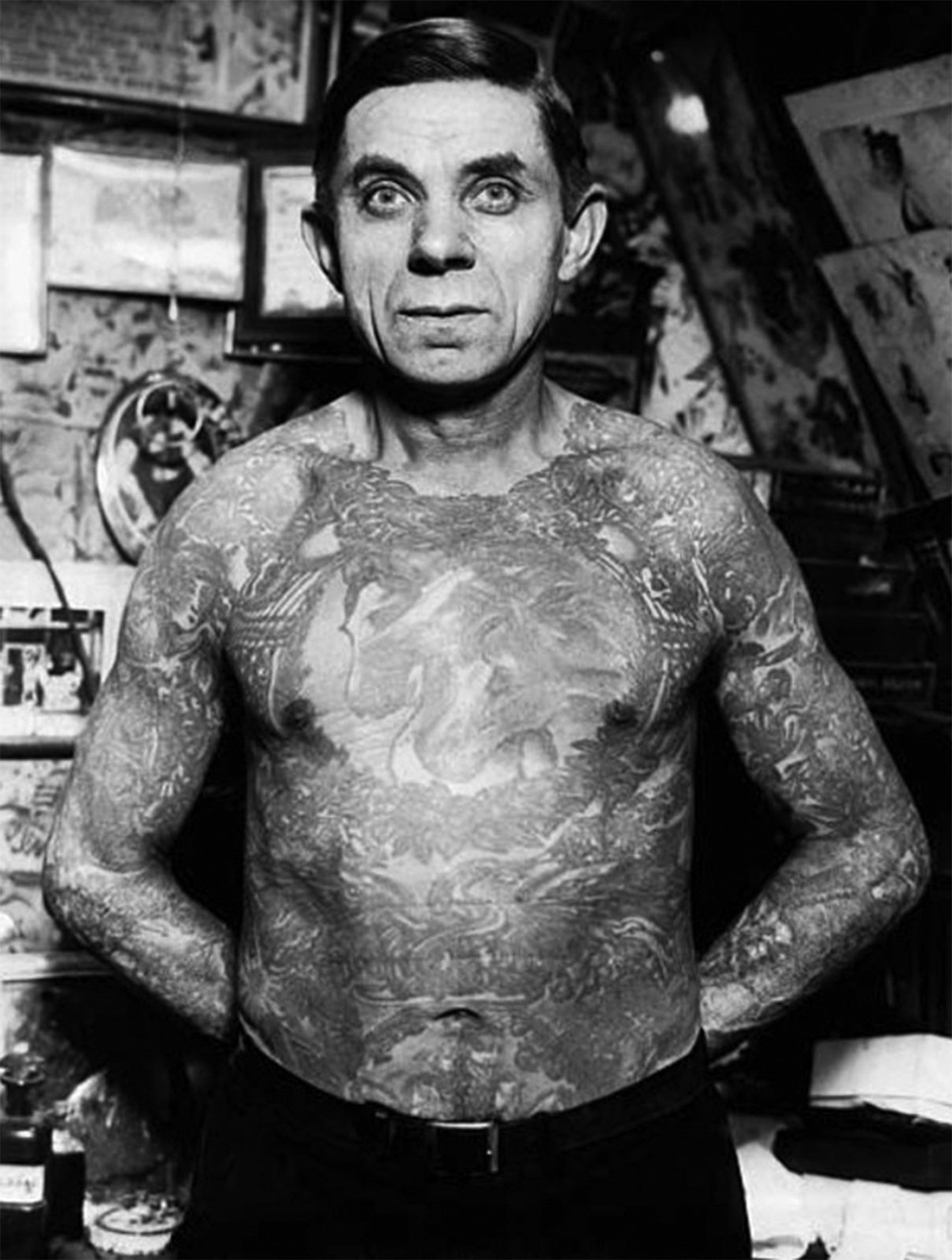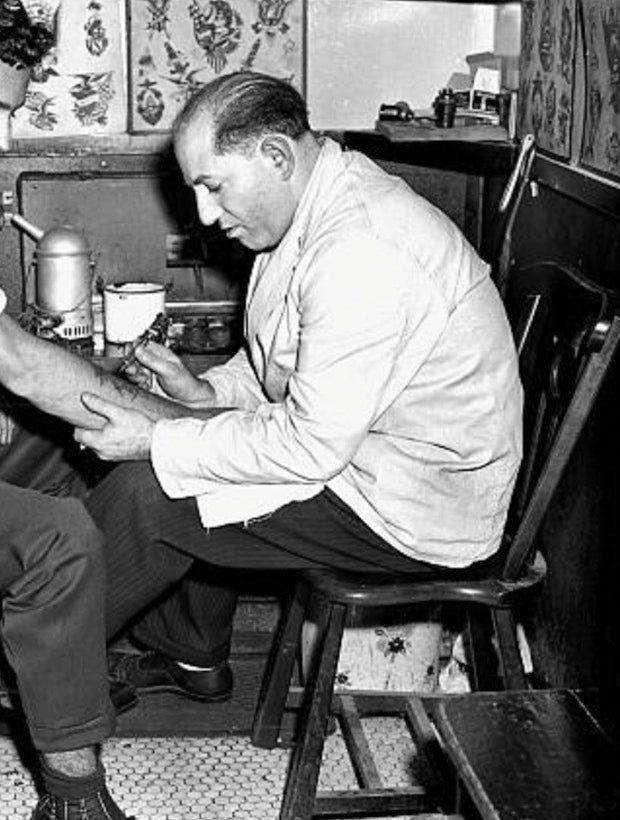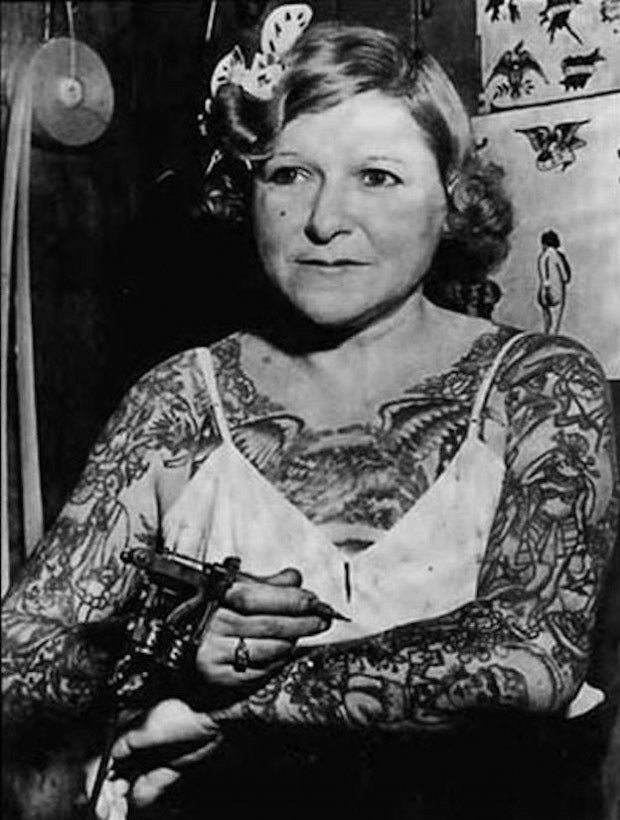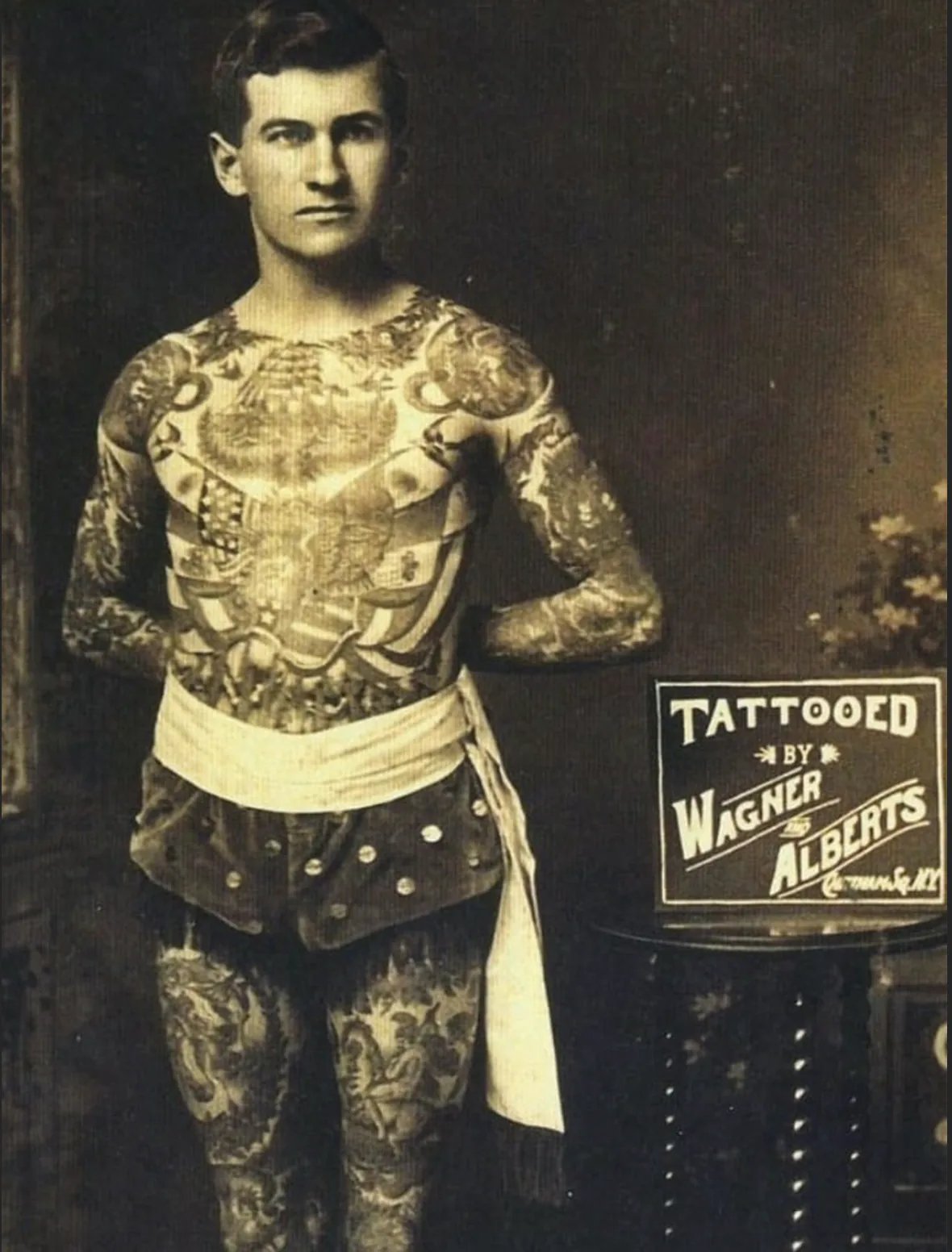

John Harry Loryea Jr. was born in 1892 in Antioch, California, the eldest son of a Jewish photographer and hog farmer.[1] On the Bowery he was Apache Harry: long hair, a stage name, a trunk of designs, and, from 1935, a studio at 22 Bowery that a later marker still lists.[1][3] During the Depression he made much of his living tattooing Social Security numbers.[2][1] This page follows him from the carnival lot to those two Bowery addresses, and it leaves the 1936 Life photographs, whose rights are unclear, off the page.
Quick facts
- Born
- 1892, Antioch, California, as John Harry Loryea Jr.
- Died
- October 5, 1940, in his shop at 2 Bowery
- Known as
- Apache Harry; the name was a stage name
- Shops
- 22 Bowery (from 1935); later a second shop at 2 Bowery, where he died
- Earlier work
- Carnival and sideshow circuits, 1928–early 1930s, as a “tattooed terror”
- Prices
- Later press said 50 cents to $10
California, a stage name and the carnival years
The most careful account of the family is Carmen Forquer Nyssen’s catalog essay for Massie’s Antiques, written around a cabinet card of Harry’s father.[1] The younger Loryea was born in 1892 in Antioch. The family was Jewish. The name “Apache Harry,” the long hair and the billing as a “tattooed terror” were show-business choices, not a record of ancestry.[1]
He later said he had learned to tattoo in Manila in 1902 from a Japanese hand-poke master. Nyssen treats the story as a tall tale, and so do we.[1] What can be described are the tattoos he showed: a flag piece on his chest and a Last Supper on his shoulder, among others, and a trunk he was said to carry with some five hundred designs.[1]
In 1928 he was with Pyle’s “Cross Country” carnival in Pennsylvania and New York.[1] In 1929 he was in Brownsville, Texas. In 1930 he was with the Rice & Dorman Carnival and the Donald McGregor Shows, then with the Craft Shows in California.[1] The itinerary is a standard mid-level carnival route of the late 1920s, and it is how he arrived, already tattooed and already billed, at the Bowery.
22 Bowery, 2 Bowery and the Depression trade
In 1935 he opened a studio at 22 Bowery.[1] The 2016 historical marker at 11 Chatham Square includes that address among the shops of the old tattoo district.[3] He later had a second room at 2 Bowery, and it was there, on October 5, 1940, that he died of a heart attack.[1]
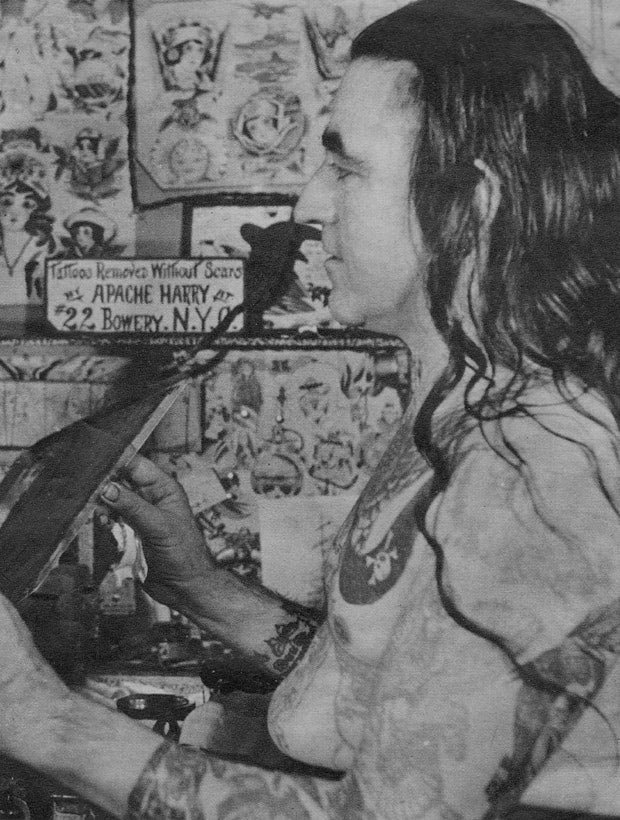
The mid-1930s press found him useful copy. In December 1936 Life ran a two-page color spread of the Bowery shop: the bench, the flash, customers named Michael Brandmaier and “Six Ring Dutch.”[1][2][4] Those photographs are not reproduced here. A 1936 Milwaukee Journal piece said he put beauty spots and initials on about a dozen women a day.[2] In 1937 syndicated stories called him a “black eye specialist,” and a James Aswell interview praised Social Security for sending him a new kind of customer: people who wanted their numbers tattooed, a “swanky, sober mid-day and morning trade.”[1]
In 1938 a NANA interview by Joseph Adams described a “little two by six cubicle.”[2] The same year’s Coronet profile was titled “Apache Harry: Who Has Reaped Social Security’s Most Generous Dividend.” He charged, the later summaries say, from fifty cents to ten dollars.[2] He also did tattoo removal and the black-eye makeup Bowery barbers had long advertised.[2]
A 1940 Laff photograph, and a portrait study by the printmaker Eli Jacobi, also survive in other collections and are not used on this page.[2] The record that is used here is enough: a California carnival performer who took a Bowery room, worked the Depression’s odd new jobs, and died in the second of two shops, a few doors from where he had started.
NYC Tattoo Shop is at 141 Canal St, a short walk from 22 Bowery and 2 Bowery. The history here belongs to New York. We’re proud to work nearby.
Photo gallery
From the NYC Tattoo Shop History Digital Archive. Period magazine photographs from Life (December 1936) and Laff (1940), and an Eli Jacobi print, are not reproduced here because their rights were not cleared.